Welcome back, my fellow creatives!
Well, the little Bs are preparing for school, and my own term is winding down as the next one looms. The summer continues to be sticky and bug-addled, so I am more than happy to herald fall with all the fanfare I can muster.
In the midst of research on helping students strengthen critical writing skills, some colleagues wanted to host a panel discussion on Adam Grant’s Hidden Potential: The Science of Achieving Greater Things. Grant is an organizational psychologist who takes a unique look at how folks grow and change. I found one of his chapters particularly applicable to the writing life and wanted to share it here.
The chapter is: “Getting Unstuck.” Rather a theme of mine this summer, you could say. 🙂

When you’re stuck, it’s usually because you’re heading in the wrong direction, you’re taking the wrong path, or you’re running out of fuel. Gaining momentum often involves backing up and navigating your way down a different road—even if it’s not the one you initially intended to travel.
Grant utilizes a case story to help structure every chapter of his book, and “Getting Unstuck” is no exception. Here, he shares the story of legendary baseball pitcher R.A. Dickey, a man who showed phenomenal potential as early as his teens (complete with an Olympic medal during his college years), but because of a medical oddity in his throwing arm, he was derailed off his path to success. He had to hunt down new guides and essentially relearn to throw to meet his physical needs. It took nearly twenty years, but that also meant that by age 35 (a time most pitchers retire), Dickey became one of the top pitches of the major leagues. His path of progress was FULL of stops and starts, but those extra challenges and detours created a transformation that set Dickey apart from other pitchers.
Writers can feel this, I’m sure. After all, it is so, so exciting to hear back from an agent or publisher. To sign that contract. To build a rapport with the editor. To prepare the marketing campaign.
And just as suddenly, eeeeeeeeeeverything comes to a halt. The numbers don’t meet the publisher’s goals. You’re not hearing back from as many bookstagrammers and book bloggers as you’d hoped. The reviews are barely trickling onto Goodreads or Amazon. Your contract ends. Interest in your books wane.
You’re stuck.
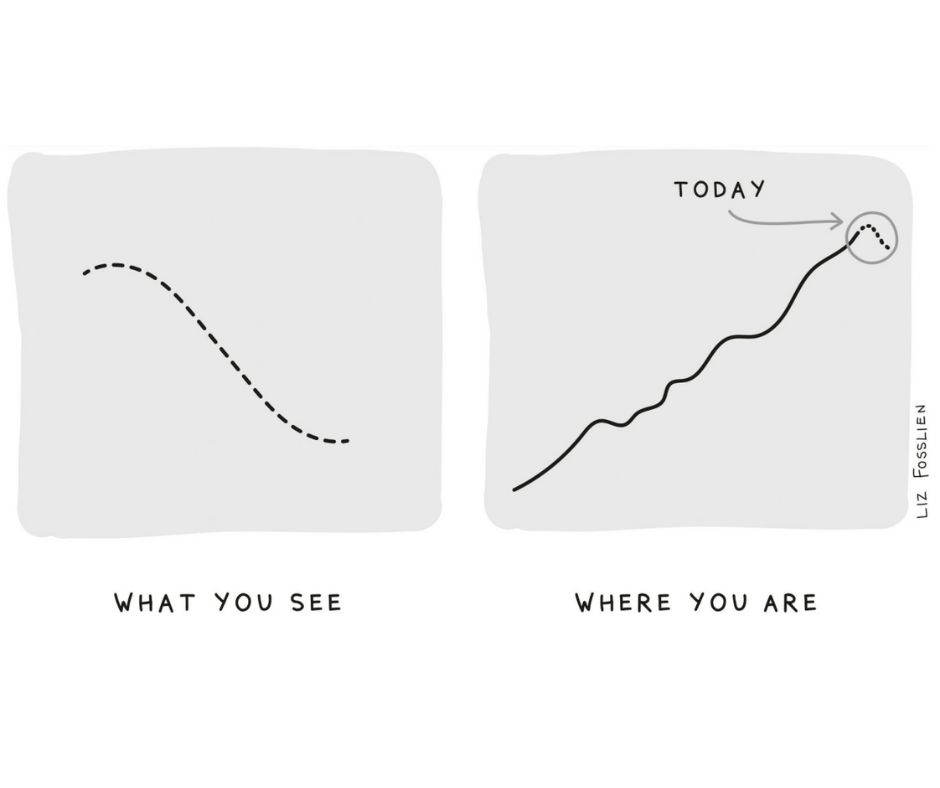
And yet, we’re not. We’re not thinking of how far we’ve already come, nor are we thinking of the potential paths still open to us. Instead, we are frustrated with the here and now and what isn’t with us in the here and now.
Progress is rarely noticeable at a snapshot in time—it unfolds over extended periods of time. If you focus your attention on a specific difficult moment, it’s easy to feel stuck. It’s only when you look at your trajectory over the course of weeks, months, or years that you appreciate the distance you’ve traveled.
As Grant explains, progress takes many shapes. Every lesson learned is knowledge gained and skill strengthened. After all, Dickey went through the same thing. When he learned that knuckleballs would be much easier on his throwing arm, he undertook a rigorous learning process to acquire the skills and guidance necessary to throw a consistently effective knuckleball. As he tells Grant, “[Dickey] estimates he threw over 30,000 knuckleballs at brick walls, cinder blocks, and nets before he had a consistent command of the mechanics.”
30,000.
Just think of that.
Our stories are built with thousands of words. But we do not keep all those words. Hundreds, if not thousands, are cut. Moved. Added. Cut again. We are forever testing ourselves and the story’s language to find that command of our own narrative. We spend weeks, months, even years on a single story until we can give it the green light. When I think about the number of characters I added and cut Fallen Princeborn: Stolen over the eight years that passed before publication, I see a LOT of going in circles.
Heavens, I know this same “stuckness” in my own teaching career. I was an adjunct for over ten years, eternally in the purgatory of “Will I have a job next term or not?” You really feel like you’re not progressing towards a path of stability.
But Grant reminds academics and creatives alike that all the spinning is not in vain.
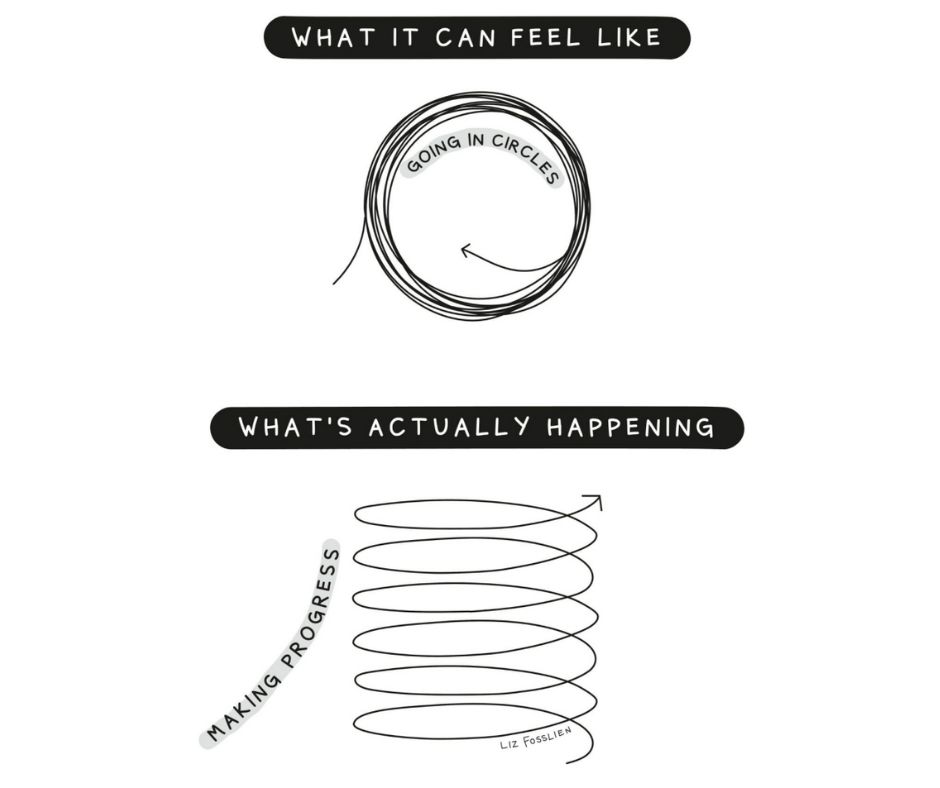
When you get stuck on your way up a mountain, it’s better to shift into reverse than to stand still. As you take U-turns and detours, you’ll feel as if you’re going in circles. In the short run, a straight line brings faster progress. But in the long run, loops lead to the highest peaks.
As a teacher, I started taking workshops and giving presentations for fellow faculty, and that got me noticed for the full-time spot. As a writer, I detoured away from the series started with a publisher so I could fully embrace the creative journey on my own terms. Perhaps the detour will take me back to River Vine someday, but for now, I have a new path to explore through a peculiar, silent universe yearning to find its song. That “undiscovered country,” as Shakespeare (and Captain Kirk) once called it, cannot be found when one clings to the safe and familiar. That, my fellow creatives, will leave you stuck.
So if you are seeing only circles and no way forward, then perhaps it’s time to venture off into the wilds of your WIP. Try a new point of view, a new setting, a new voice, a new genre, a new publisher.
Yes, you will stumble.
And you will try again.
You are still, in your own way, making progress.
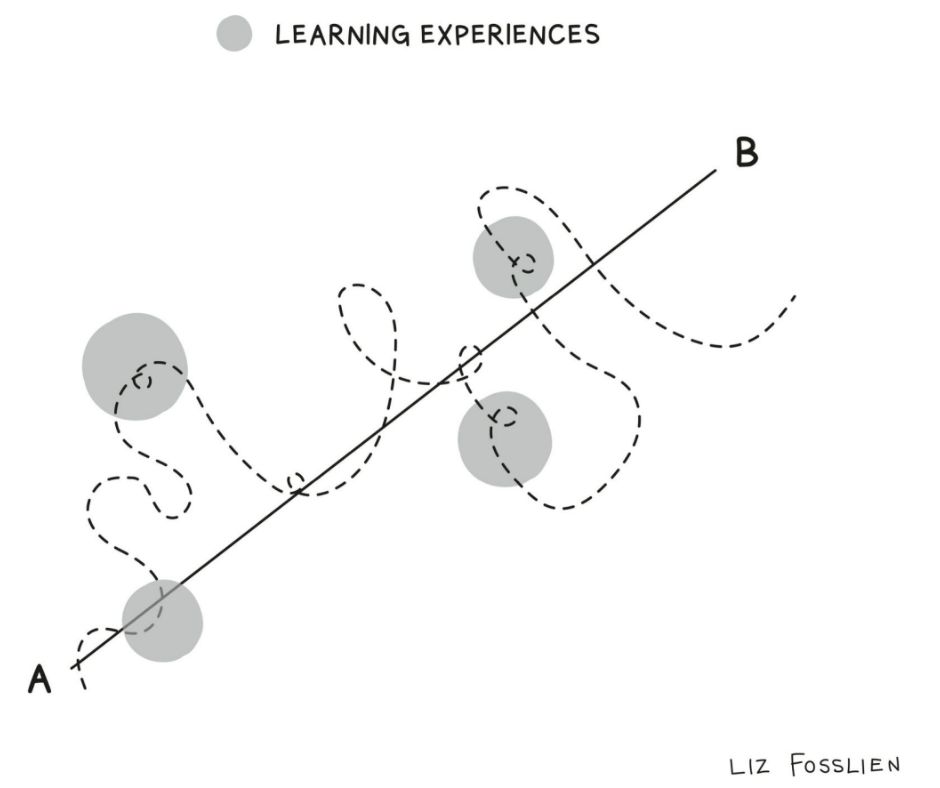
Making progress isn’t always about moving forward. Sometimes it’s about bouncing back. Progress is not only reflected in the peaks you reach–it’s also visible in the valleys you cross. Resilience is a form of growth.
What helps you get unstuck? I’d love to hear about it!
As for next week, it’s about time for another podcast, so we’ll see what the library holds for us.
Read on, share on, and write on, my friends!


What a fascinating blog and a good take on book writing. All that struck me odd was the remark, ‘…you’re heading in the wrong direction; taking the wrong path…’. I’m no expert, but to me ‘the wrong path’ is the very thing that triggers my imagination. That said, we are all different, like chalk and cheese. All the best, Mike
LikeLiked by 1 person
Yes, Sir, those wrong paths do make one wonder what their “wrong-ness” could possibly be…certainly worth an explore, in my book…. xxxxxx
LikeLiked by 1 person
Excellent points, Jean. I know I don’t always write linearly (meaning I work on bits that I get inspiration for, and later work on trying to connect them) and not always on the same project, but that helps sometimes.
LikeLiked by 1 person
Right! Sometimes our attention diverts down different paths, and that’s okay because it helps refresh us for that primary journey.
LikeLiked by 1 person
I am not completely unstuck yet, but one thing I enjoyed was taking my characters and putting them a random somewhere or occasion, then making up a conversation they would have in that setting. Not for the book, but just to get to know the characters.
LikeLike
Oh yes, I hear you! I did that with a different story some years back, and I ended up with scenarios I’d love to include in the book. I just have no idea how, lol.
LikeLiked by 1 person
I’m not so much stuck on my blog as distracted by sparkly (more tempting) things.
LikeLiked by 1 person
Oh yes, the sparklies can be quite effective!
LikeLiked by 1 person
I remember a rock star talk about never working linear. Developing some music, some words then at some stage trying to link them. He said his best songs were the rare ones which came linear to him, no linking required, they naturally flow. xxxx
LikeLiked by 1 person
It really is a rare thing–it’s only happened to me a few times, having a story come out like that. It’s amazing how time is absolutely lost when one finds that groove! But I’m glad for those journeys where I had to tough it out, too. xxxxxx Hope you’re well!
LikeLike
Unstuck? Definitely! And worse… But now I’m getting a boost, although the ups and downs, and whirling around is… interesting?! Another book from me? Maybe, one day.
LikeLiked by 1 person
I’m rooting for you, my friend! xxxxxxx
LikeLiked by 1 person
As I sit here struggling to write the first lines of the synopsis for my new novel, I feel every bit of this blog post. I’ve been writing for over 25 years now and this will be my third endeavor, yet the synopsis never gets easier. I’d rather write the whole dang novel than the synopsis. Moreover, despite this being my third foray, I am still struggling with how to move forward, get traction, build an audience, etc. It almost makes no difference if you are a good writer because without the audience, you are just another person scribbling in the dark. Perhaps this time things will change, perhaps not. I do know that writing does something for my soul that that no other medium or form of interpretation does for me so I will keep at it regardless of how many times I have to get back up. Thanks for this post, Jean. It reaffirms my resolve. Have a great day. Pam
LikeLiked by 1 person
Argh, YES! Synopses are HARD! I was trying to draft the synopsis of my WIP to share with a friend of mine, and it took for-flippin’-ever. Recovering lost ground in platform-building isn’t easy, either, and I feel like I’m in a sort of panic mode about it. The important thing is that you are doing what your soul needs to thrive, and for that, Friend, I am so very happy for you! Let us both remember that all these loops and detours will still get us where we need to go. xxxxxxx
LikeLike
Yes, and that’s truly the bottom line. All these detours eventually serve us.
LikeLiked by 1 person
Thank you Jean Lee. I, like everyone else, gets stuck. Once I got stuck for fifteen years, but then got unstuck, The stuck-unstuck syndrome is “material” for an author..
LikeLiked by 1 person
It is a peculiar feeling, to be sure, but very, very real. I’m glad you’re unstuck and moving forward! xxxx
LikeLike
Thank you Jean Lee.
LikeLiked by 1 person