Welcome back, my fellow creatives!
Here we are with another Halloween on the horizon. A little surreal, I admit, because this is the first year my kids are not trick or treating. I don’t know who gave them permission to grow up like this, but it certainly wasn’t me.

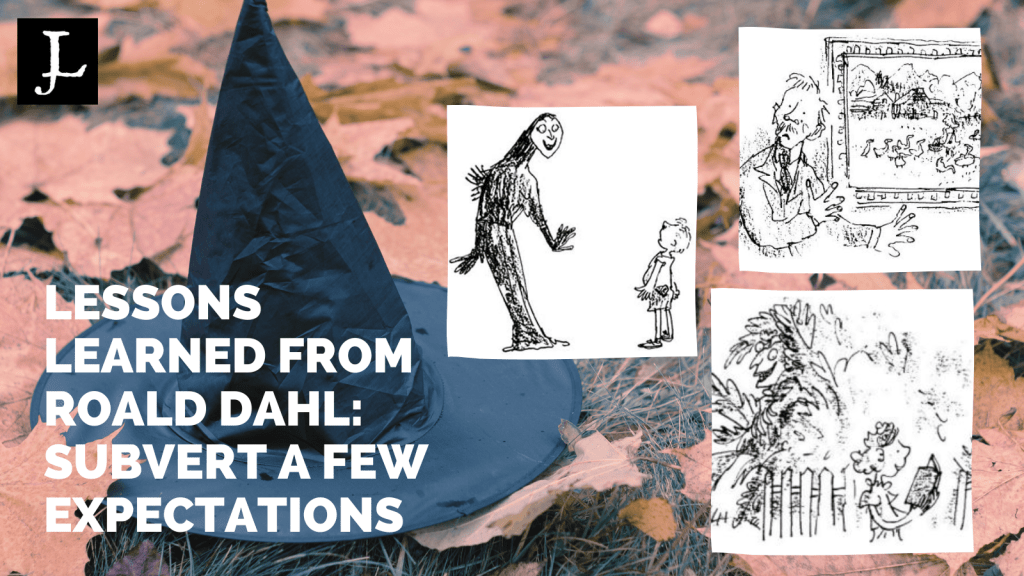
Today I wanted to highlight something cool about witches and expectations for the monsters we think we know. Countless folk and fairy tales about witches have been told over the centuries up until the present day. But the particular story I want to focus on. Was something I didn’t even read so much as watch, and that was The Witches by Roald Dahl.

Unlike most readers, the movie was my first exposure to this story, and the movie absolutely terrified me because it messed with the expectation that a witch looks a certain way.

As a kid, what do you think witches look like? Like the green witch in The Wizard of Oz. Like the creepy hag queen in Snow White or Sword in the Stone or MacBeth or ANY story that involves magical crones. Even something like Hocus Pocus shows witches with exaggerated appearances, clearly unnatural and stand-out-ish in today’s world.
And then here comes Roald Dahl with this gem:
REAL WITCHES dress in ordinary clothes and look very much like ordinary women. They live in ordinary houses and they work in ORDINARY JOBS.
That is why they are so hard to catch.
Dahl scares kids like me with the concept that a witch looks no different than an everyday person. Yes, they have physical differences, but they are aaaaaaaaall differences that can be hidden: claw-like hands beneath ladylike gloves, peeling scalps beneath wigs, absent does inside normal shoes. The fact that Monsters hide among the Humdrum of the Every Day is SCARY, especially when kids are often taught to be wary of creeps and strangers in cars, but those creeps are usually pictured as men.
For all you know, a witch might be living next door to you right now.
Or she might be the women with the bright eyes who sat opposite you on the bus this morning.
She might be the lady with the dazzling smile who offered you a sweet from a white paper bag in the street before lunch.
She might even–and this will make you jump–she might even by your lovely school-teacher who is reading these words to you at this very moment.
(That might be why no school teacher of mine ever read this book to the class.)
Now an extra level of altering expectations comes with how witches deal with children. Plenty of tales show witches eager to destroy innocence, whether it’s stealing their youth, killing them, eating them–death tends to be the endgame in all cases.
But Dahl does not have witches going quite that blatantly gruesome as stuffing children into a candy house’s oven.
No, these witches would change the children.
The book’s protagonist is in the care of his Norwegian grandmother, who tells him a number of stories about her friends’ fates with witches. Now again, I saw the movie before the book, so I didn’t know Dahl’s opening examples of what witches would do: turning one kid into stone, another into a chicken. As a kid, I imagine I’d think that weird, but not terrifying. Nope, THAT story is coming, and it was used in the movie, too.
Witches never get caught. How could they, when they never leave a trace like blood or bone? How can they, when witches do things like magick a child into her family’s own artwork? Cursing the family to watch their own child grow up, grow old, and die IN THE PAINTING?!
And as a kid, THAT is horror: to be in permanent danger, visible to those I love, but completely cut off from and unable to be saved.
But those are the stakes Dahl establishes in the first 20 pages of his book. The protagonist hasn’t even met a witch yet, but now we know that the typical expectations of witches are not present here. Yeah, they want to get rid of kids, but there is a sadistic pleasure here to it, a torture of innocence. And in this particular story, the Grand High Witch has created a way to not only decimate the children of England, but to eradicate them at the hands of their own parents: a magical potion in chocolate bars will turn all kids to mice, and what do adults do to mice? Kill them.
For a child–for anyone, frankly–to know the people you love and who love you would kill you without knowing it–that, my friends, is horror.
~*~
There is another altered expectation that I think is worth mentioning here unrelated to the horror of what the witches do. This time, we’re talking endings.
As a kid, we’re looking for that “happily ever after” moment, where the child shoves the kid into the witch into her own oven and gets away, where a hero comes in and hacks evil open and lets the child out.
[Spoilers, I suppose, but this book and film have been out for decades so I don’t know why a disclaimer’s needed so here we go.]
Now both the film and story end with the witches getting their comeuppance: the mouse-ified protagonist is able to drop the mouse-making formula meant for kids’ candy into the hotel’s soup served to all the witches. Even the Grand High Witch is transformed into a monstrous mouse that screeches as the hotel staff goes to town doing what the witches wanted for the children–pest control.
Now the big difference between book and film is with the white-clad assistant to the Grand High Witch, who’s not in the book at all. This witch never eats the soup and even transforms our protagonist out of his mouse-hood and back into human form at the end of the movie. The boy can hug his grandmother, all is well, the end. (You see this in the trailer for reasons I do not at all understand.)
But the book doesn’t do that at all. In the book, the protagonist remains a mouse.
“How long does a mouse-person live, Grandmamma?”
…
“A mouse-person will almost certainly live for three times as long as an ordinary mouse,” my grandmother said. “About nine years.”
“Good!” I cried!. “That’s great! It’s the best news I’ve ever had!”
“Why do you say that?” she asked, surprised.
“Because I would never want to live longer than you,” I said. “I couldn’t stand being looked after by anybody else.”
When I first read this, I didn’t understand. Where was the happy ending? Where was the magical change back to the way things were?
As an adult, though, I think I understand.
Fighting evil changes a person.
We can’t hide those changes, nor should we try.
Granted, those changes aren’t always as drastic as becoming a whole new species, but those changes do happen. To disregard that is a cheat to all the protagonist endured, and to the readers, too.
The Monsters must know that know matter what they do, they cannot win.
And it is up to us as storytellers to share that lesson as often as we can with the next generation.
Thank you so much for hanging out with me today. Do you have a favorite spooky story for the season? I’m going to see if I spot something a touch wicked for this month’s podcast. Stay tuned!
Read on, share on, and write on, my friends!

 Jean Lee's World
A worthy blog. Fascinating. I liked it a lot. All the best, Mike
LikeLiked by 1 person
Thank you, my friend! I’ve been wanting to write about this story for ages, and I finally got the chance this year. x
LikeLiked by 1 person
A teacher showed The Witches film to my nephew at school. Talk about terrified.
LikeLiked by 1 person
Oooooh yes. The 80s was quite the time of dark fantasy. Next year I’m keen to write about RETURN TO OZ and all *that* nightmare fuel. Yowza. xxxxx
LikeLiked by 1 person
Yowza is right! xxxxx
LikeLike
Great post! No fav story, tho. I think I read / watch too little of the genre to really have an informed opinion. But I liked the way you highlighted why this story worked so well. I´ll put this on my watch-list.
LikeLiked by 1 person
Thanks! I was speaking with my daughter Blondie about book vs. film versions of stories. While we both LOVE Jim Henson’s witch-work and mice, we both love the book’s ending more…unlike SECRET OF NIMH or CORALINE, cases where we both adore the films but not the books. And we still argue about HOWL’S MOVING CASTLE even though I’m Mom and should clearly win that argument, lol.
LikeLiked by 1 person
That was interesting, although I haven’t seen many of those… wonder why?
(I might be a bit old, but I still get a bit scary about some of those witches!)
LikeLiked by 1 person
Well I think the movie’s long been lost to mainstream audiences, and then the remake came out during COVID that relies waaaaaaaaaaaaaaaaaaaaaaaaaaaaay too much on CG for me to bother. 😦 The book honestly would have weirded me out as a child. I suppose this is one way to teach Stranger Danger–just like the Grimm tales of old! xxxxx
LikeLiked by 1 person
I read the book first, not my favourite Roald book but it’s still good. I actually liked the movie better than the book for some reason. xxxxx
LikeLiked by 1 person
Oh yes, I hear you about the books. The books can be very “up and down,” as it were. THE TWITS is such a bizarre tale, and I think Blondie has loved MATILDA most of all…perhaps because there’s a quirky young girl wreaking havoc on the adults, lol…
LikeLike