I suppose this topic was bound to happen at some point, being both an educator and a writer.
So I mentioned a post or two back that I had attended a conference…I was presenting with a colleague of mine regarding the importance of helping students take an active role in their writing work. This has sadly been a debate in higher education ever since ChatGPT hit the scene. There were articles about the death of essay writing and that there would no longer be a need to teach composition. Are we just grading bots with the help of other bots? Because there’s plenty of AI programming out there, and plenty of AI help and support for students and teachers alike. Programs like Magic School can create feedback for teachers to share with students. I’ve seen it in action and plenty of students since last year have put ChatGPT to use in my classroom to turn in vague, milquetoast work. It’s become a struggle to show students that it is worth the extra time and effort to strengthen the power of their own unique voices.
As a writer, I have been fascinated by the lawsuits out there regarding AI being trained with public material like blog posts or on books written and published and copyrighted. These authors’ voices are being taken from them by strangers throwing a prompt into a program to create without any effort on their own part.
It’s sad because there is so much pressure in the academic sector to be excited about AI. And then there came creative groups like NaNoWriMo getting sponsored by a generative AI company; if you question it, you are racist and ableist.
I wish I was making that up. This YouTuber breaks it down fairly well.
This is bullshit.
And heartbreaking.
You saw me writing for NaNoWriMo here on this blog in years past. NaNoWriMo embodied the great challenge of discovering ideas and skills you didn’t know you had as a storyteller. But with something like generative AI, the motivation to push yourself just evaporates.
I see it firsthand every term, and not just with the students using it to pass off as their own work. I’ve spoken to educators who, after saying AI is wonderful in meetings, will tell me in a hallway that this is one of the worst things to happen to students because it drains any desire for active agency.
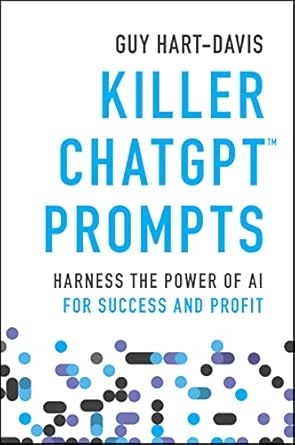
And it doesn’t help when there are books coming out like Killer ChatGPT Prompts by Guy Hart-Davis. It’s a book that came out last year and it’s all about amaaaaaazing prompts to use for getting a job, managing your work, for business writing, for research, for teachers, for students, for sales, for creative writing, and more. I got this book from the library so that I could share some of its points with you and show you why, as an educator and creator, I feel as I do about generative AI.
First, let’s look at the prompts for teachers. They open the chapter reminding teachers that it’s up to them to make students use AI ethically in spite of all the concerns with academic integrity. But then Hart-Davis encourages teachers to use ChatGPT to write course syllabi, goals, and objectives.

Shouldn’t a teacher know their own goals and objectives for a class? Shouldn’t they know their own course material for tests and lesson plans since they are the ones teaching it? Once again, it sounds like generative AI is taking away the active agency of a teacher. And you can even have ChatGPT write notes to parents and students. God forbid you, as the teacher, actually take ownership of connecting with your students or their parents.
The chapter on prompts for students is no better. I quote:
If you’re a student, you won’t need me to tell you that ChatGPT and other generative AI tools are a point of contention between students and teachers at present. Understandably enough, students want to leverage this exciting new technology to get their school work done faster, better, and more easily. Whereas teachers also–quite understandably–want students to put in at least the traditional amount of thought, effort and research to ensure that they actually benefit from their courses. … Pasting the assignments topic into ChatGPT and submitting the result as if it were your own work, will do neither you nor your teacher any good. The teacher is likely to notice that the assignment is not written in your voice. The teacher may also spot other clues that the assignment was written by AI, either simply by reading the text or by inputting it into an automated checker. If so, you and your teacher will no doubt have an uncomfortable conversation.
Nowhere in this chapter does it say that copying is wrong. It just “won’t do you any good.” Meanwhile, they give you tips on using prompts to get ChatGPT to give you the answers to homework problems, “kickstart” assignments, and revise your work. As I try to explain to my students, having AI do the writing for you is the equivalent of telling the computer to prepare you for a marathon that you’re supposed to be running. But if the computer shares the recommended diet and exercise regimen and you do nothing, just how ready will you be that day of the marathon? If you let the computer do all the work, you gain nothing. If you take AI’s findings about diet and exercise and put those ideas to work, you are physically doing something and challenging yourself to be better. I show this to my students for writing, as well: AI can, at times, point us in the right direction for research, or list some concrete solutions to problems that students can then develop with their own writing. But when it writes for us, we are no longer challenging ourselves. We are no longer strengthening our skills. We critically and creatively atrophy.
Speaking of creatively, the chapter for creative writers is particularly sad. On the one hand, I like how they feel that ChatGPT can help you with your writer’s block. Doesn’t that sound nice? Sure, I know I’ve struggled with writer’s block aplenty. I went through a stage with my Fallen Princeborn novel where I revised the whole story to put a new character in to solve problems with the plot, only to realize I just made new problems. So, I had to go through the novel again and pull that character out. That took months of work on top of raising tiny children and teaching part time. It sucked. Yes, I would have loved to save myself that time, yet I also learned by doing. I learned what made that new character work and NOT work, and grew as a storyteller as a result. How does having ChatGPT create an entire plot for you help you grow as a writer? How does that push critical creative skills? Or having ChatGPT make a scene for you. Having ChatGPT make a character or start your story, or having ChatGPT make your dialogue. Perform rewrites.
Where is the work? Where is the EFFORT? I don’t see where the effort is here. All I see are shortcuts to critical and creative apathy.

I will not say that ChatGPT and other generative AI programs are the doom of human creativity. That’s extreme. After all, any grammar check is AI, and it certainly helps me catch a fair amount of snafus. The difference is that such AI is limited in its application. What worries me is that the legitimate concerns about AI’s impact on growing minds have been quickly dismissed in the interest of getting things done faster and more easily. We don’t have to work nearly as long or as hard on our writing anymore! I don’t have to worry about whether or not I said something correctly because the program will do it for me. It will plan it for me. It will draft it for me. It will revise it for me.
The desire to understand, to connect, to work for connections with one’s audience through words, the motivation to dig into language and find the best word choices to share one’s logic and evidence–it is shrinking, and shrinking fast. All we can do, my friends, is show others this fight for creative, critical thought is worth every bloody minute. For our classrooms. For our stories. And for us.
~*~
What are your thoughts on AI and its generative programs when it comes to making letters and office plans and stories for you? I’d love to hear about it because. This issue is not going away anytime soon. Coming up, though, let’s get creative, shall we? I’ve got a prompt from my university I am trying to follow and it called me back to the concept of comfort food–not just to eat, but to watch and imagine and enjoy. So let’s have fun with that.
Read on, share on, and write on, my friends!

 Jean Lee's World
AI has always been something that has troubled me. To refer to Jeff Goldblum’s statement on Jurassic Park, just because you can do something–or invent something–doesn’t always mean that you should.
LikeLike
Oh yes, exactly. It reminds me so much of the Matrix films, too–the more skills we hand over to machines for the sake of convenience, the less we are able to do ourselves. How far do we really want to take that? Almost like an evolutionary regression.
LikeLiked by 1 person
Indeed.
LikeLike
Good grief this is dreadful. Ugh and ugh again, I don’t know much about this AI but it’s not good. Not good at all. I do know that Amazon is very keen to keep AI out for people who are writers… a little help. Maybe.
LikeLike
Oh I’m sure it’d look bad for Amazon if their publishing sphere got used for AI training. It’s bad enough WordPress and Meta/Facebook are involved. 😦
LikeLiked by 1 person
Here in Central PA, high school kids are using AI to make fake nudes of fellow classmates, the latest in AI-created scandals. I just don’t like it for so many reasons, Jean.
LikeLike
YES. The fake photos are just as bad as the fake texts. And that’s the thing–they talk about how uplifting and freeing these programs are, but they don’t work that way. Lots of ideas sound good on paper until human nature gets involved. 😦
LikeLiked by 1 person
So true!
LikeLike
AI opens up all kinds of ways to cheat, demean, destabilize, etc., etc.
LikeLike
It certainly does. And for all the rhetoric praising its potential, I see very little genuine improvement in how we communicate.
LikeLiked by 1 person
What an interesting article, friend
LikeLike
Many thanks!
LikeLike
AI troubles me. Well not the AI but how it can be used. Must admit that has been the basis of some great books and movies xxxx
LikeLike
Oh sure, the films can be fascinating, like the MATRIX. I wish AI was boosting our intelligence, but not so much…
LikeLike
[…] My thoughts on AI are quite clear. But I do enjoy seeing how AI mucks things up, such as the steam from some distant caboose rather than, you know, the engine. 🙂 Bo says that’s cosmic propulsion, lol. […]
LikeLike