
Welcome back, my fellow creatives!
It feels fitting to return to my Lessons Learned posts with a talk about setting, as it’s a favorite element of mine to study and its role in effective storytelling cannot be understated.
But why on earth am I using the Jack Reacher series to do so?
Years ago Tom Cruise starred in a film adaptation, and I dug it at the time. When Amazon announced a television series, I wondered if the series had the material to make it work. I visited my local library, found Lee Child’s name on the shelves and HOLY COW THERE ARE A TON OF THESE.

Pulling my podcast maneuver, I grabbed a random volume and checked it out. Turns out I selected the fifteenth installment of the series: Worth Dying For.
The Reacher series is about a former Military Police officer-turned-vagabond detective, ever wandering from one town to the next, taking on rural and urban villains alike across the country because shit’s happening and someone’s got to do something, dammit. I have to admit, the premise reminded me a little of cult-favorite tv shows like The Incredible Hulk and The A-Team.
What particularly got my attention reading Worth Dying For is the rural environment. Even other Reacher novels I’ve read, including Make Me, 61 Hours, and A Wanted Man include the rural element, and I can see why: Child knows how to hide a lot where one would think there’s no place to hide. It fulfills the observation Sherlock Holmes made long ago in “The Adventure of the Copper Beeches”:
They always fill me with a sudden horror. It is my belief Watson, founded upon my experience, that the lowest and vilest alleys in London do not present a more dreadful record of sin than does the smiling and beautiful countryside.
To avoid writing 10,000 words on this subject, we’ll stick with Worth Dying For. Let me share a snippet of the blurb before tucking in:
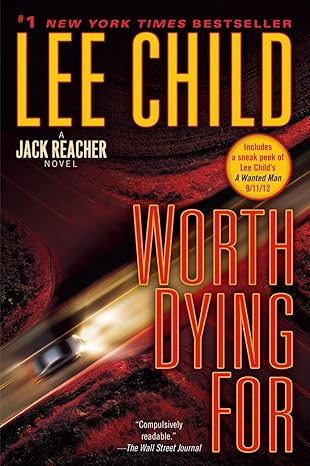
There’s deadly trouble in the corn country of Nebraska…and Jack Reacher walks right into it. First he falls foul of the Duncans, a local clan that has terrified an entire county into submission. But it’s the unsolved case of a missing child, already decades old, that Reacher can’t let go.
Okay, that should be enough context.
The first chapter does not start with Reacher, but a stranger with a rifle parked near an old barn.
The barn had been built long ago, when moderate size and wooden construction had been appropriate for Nebraska agriculture. Its function had since been supplanted by huge metal sheds built in distant locations chosen solely on the basis of logistical studies. But the old place had endured, warping slowly, rotting slowly, leaning and weathering. All around it was an apron of ancient blacktop that had been heaved by winter frosts and cracked by summer sun and laced with wiry weeds.
Three pages in, and Child uses the barn and its backdrop as a way to encapsulate the decaying, bleak landscape. So much is built, abandoned, forgotten–unless you are this stranger. And this stranger must, for whatever reason, watch over this abandoned place with a rifle lest forbidden eyes open its door. It’s an effective juxtaposition of the value-less mysteriously valued. As readers, we want to know why this barn matters so much that it’s worth killing for. (Or worth dying for, to use the title.)
But we aren’t told. Not yet, anyway.
Chapter 2 opens with us learning the stranger has been ordered to shoot “the big man in the brown coat” who of course turns out to be Jack Reacher. The chapter flashes back to why Jack Reacher is in this particular location: he hitched a ride and the ride dropped him off there.

The land all around was dark and flat and dead and empty. The motel was the only living thing in sight. It looked like it had been built forty or fifty years earlier in a burst of commercial enthusiasm. Perhaps great possibilities had been anticipated for that location. But clearly the great possibilities had never materialized, or perhaps they had been illusions to begin with. One of the four crossroad lots held the abandoned shell of a gas station. Another had a poured foundation, perhaps for a large store or even a small mall, with nothing ever built on it. One was completely empty.
But the motel had endured. It was an adventurous design. It looked like the drawings Reacher had seen as a kid in boys’ comic books, of space colonies set up on the moon or on Mars. The main building was perfectly round, with a domed roof. Beyond it each cabin was a circular domed structure of its own, trailing away from the mothership in a lazy curl…
First: I dig the repeat of “endured.” That’s a feeling, you know, in the Midwest, an invisible current flowing beneath the sloping hillsides and plains of farming country. No matter what you see from your car tooling down the highway towards a town, a farm rarely thrives. Be it rains or drought, tornadoes or fires, one must endure if one is to truly live on the land. Time, too, takes its share of farms. I’ve passed dozens of barns like Child describes in Wisconsin, only the barns themselves are often overgrown among the wilderness determined to reclaim the once-tamed countryside.
Plenty of towns in northern Wisconsin also match Child’s detail about “great possibilities” imagined for a place only for them to fall through. After all, I even wrote about such a town a couple posts back. There is little to keep people there, even less to draw people in.
So when outsider Reacher not only arrives, but stays, the aforementioned villainous Duncans are concerned.
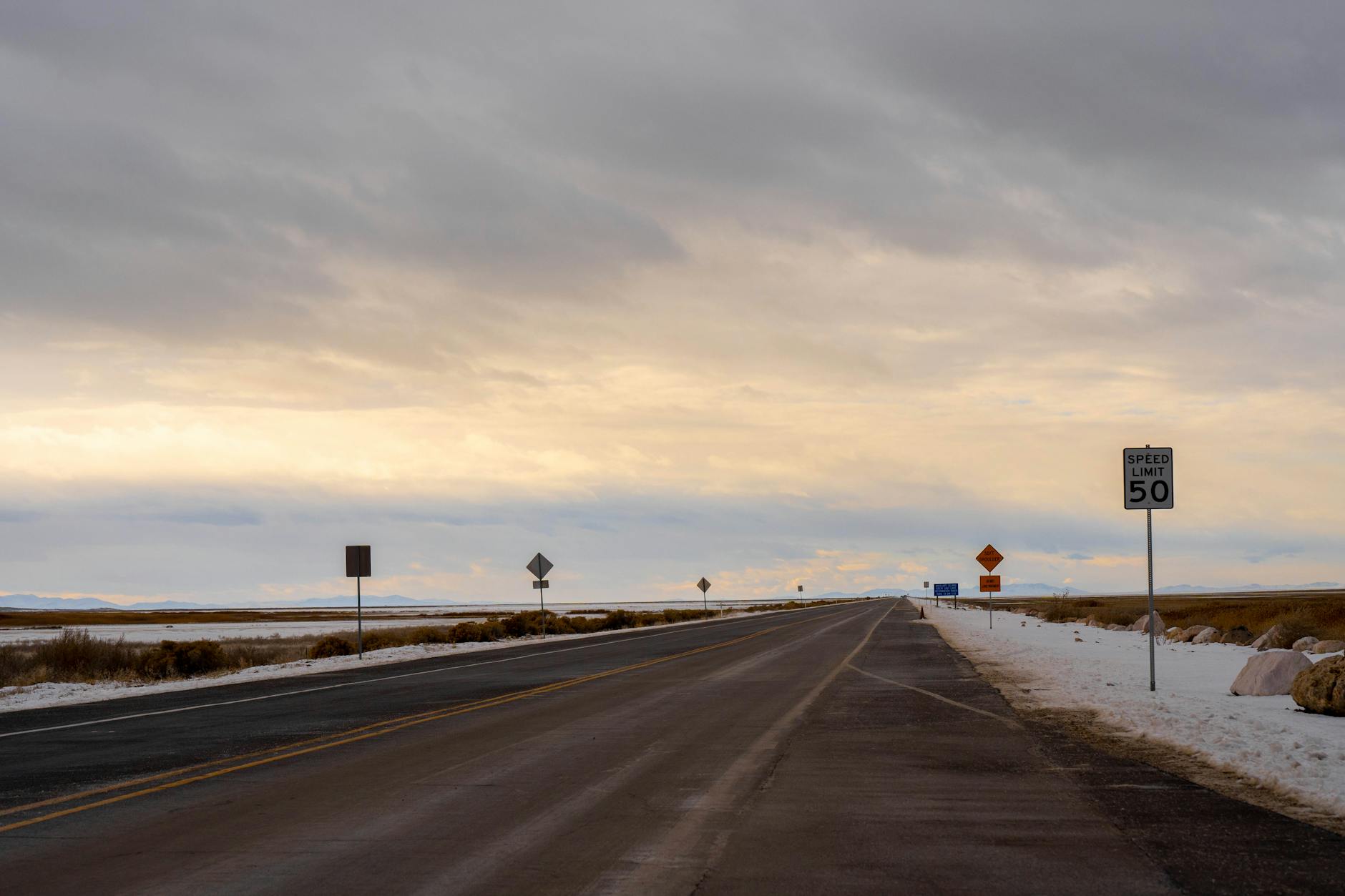
Not that they can’t find the guy. A few buildings in a neverending flat landscape leave little to hide a dog, let alone a big man in a brown coat. The roads, too, provide little variety. Flat, straight, endless. All is empty and endless.
Almost.
The road was a narrow straight ribbon, with dark empty fields to the right, and dark empty fields to the left. There was enough moonlight and enough starlight to make out shapes, but there weren’t many shapes to make out. There was an occasional tree here and there, but mostly the land had been plowed flat all the way to the horizon. Then three miles out Reacher saw two buildings far to the west, one large, one small, both standing alone in a field. Even at a distance and even in the dark he could tell both buildings were old and made of wood. They were no longer quite square, no longer quite upright, as if the earth was sucking them back down into itself, an inch at a time, a corner at a time.
We as readers know Reacher is looking at the barn of Chapter 1. In a community this small on terrain this flat, every building stands out. For life-long residents, buildings like that barn are the equivalent of white noise: merely props in the backdrop of living under the Duncans’ rule. But for a mind like Reacher’s, the barn provides a crucial mapping point to help him know where he is in all that emptiness, especially when he is tracking clues about the missing child documented years ago.
Reacher kept the three smudged shapes far to his right and tracked onward. He was used to walking. All soldiers were… up ahead was a tangle of low bushes, like a miniature grove. Wild raspberries or wild roses, maybe, a remnant, somehow spared by the plows, now bare and dormant but still thick and dense with thorns.
Wisconsin may not be so flat and empty as to have grids of roads, but the lone tree or thicket in the farm fields is a very, very familiar sight to me. (It even inspired one of my short stories for my Fallen Princeborn series some time back…I should re-publish those…ANYway.) Reacher encounters a couple of these tangles in the emptiness, one of which isn’t too far from the barn. A lone teen hides there, his whisps of weed smoke rising above the thicket as he tells Reacher about the ghost of the missing girl.

“Her ghost, man. Still here, after twenty-five years. Sometimes I sit out here at night and I hear that poor ghost screaming, man, screaming and wailing and moaning and crying, right here in the dark.”
Well played, Child, well played. The stoner’s line comes at the end of Chapter 18, roughly one third into the novel. Readers know Reacher doesn’t deal with ghosts, but clearly the stoner heard something, and that something has to do with the abandoned barn. Something terrible has happened and is still happening, and come Hell or high water, Reacher is going to find out what it is. We readers are ready to move with Reacher out into the barren landscape of winter farm fields to find out how a child could have been lost in a town so small and desolate. The endless, harsh fields combined with the vast, raw sky is its own weight upon the soul. I’m sure that played into Child’s choice of setting this story during the cold months, too, as it allows for opportunities to pit Reacher against the Duncans’ henchmen where neither can do any hiding. That vast expanse also forces one to constantly see the enemy no matter how far or close they are, and in Chapter 20 Child effectively uses that exposed approach to set tension on fire as henchmen chase Reacher down.
…[Reacher] could already see the wooden buildings ahead. They were tiny brown pinpricks on the far horizon. Nothing between him and them. Flat land. He was watching for trucks. He knew they would be coming… Reacher was dangerously exposed, and he knew it…
He turned around, slow and cautious. Nothing to the east. Nothing to the west. But three hundred yards due north was the bramble thicket he had noted before. The second such thing he had seen within a two-mile span….The thicket was the place to go.

Three hundred yards for Reacher. Slow as he was, maybe sixty seconds.
A thousand yards for the truck. Fast as it was, maybe seventy seconds.
A ten-second margin.
No-brainer.
Reacher ran.
As I gathered excerpts to share here (and yes, I know, I’ve got to wrap this up), the barn takes on a constant presence. In the first read, I noted it subconsciously, but only in this reread did I see how the barn is literally a part of the backdrop of this story: it never really leaves. If it’s not in the Duncans’ dialogue, it’s in Reacher’s interrogations. We’re staring at it through Reacher’s eyes and a mysterious sniper’s scope. We as readers are determined to find out what makes one abandoned relic in an endless countryside worth dying for.
The old barn was still locked and listing… The countryside all around was empty and silent.

Whew! I hope you enjoyed that little explore…well, not quite so little, but dangit, I forgot how fun it was to really dig into the prose like this. What else haven’t I done in a while: Music!
Let’s enjoy a little music next week. Xxxxx
Read on, share on, and write on, my friends!

 Jean Lee's World
Isn’t it a strange thing when a simple line catches the eye. This time from your blog did indeed catch my eyes, namely, “…There was enough moonlight and enough starlight to make out shapes, but there weren’t many shapes to make out…” There’s a story to create from that alone. All the best, Mike
LikeLiked by 2 people
Yes, my friend, indeed! The storytelling can be bare-bones at times, but that’s where we start, yes? With the bones. What we add to them is up to us, our characters, and sometimes the characters need little in order to show their strength.
Always happy to have you here, one Fool to Another. xxxxxxx
LikeLiked by 1 person
I’ve never gotten into the Reacher books, but I love Nina Simone.
LikeLiked by 1 person
I’m really enjoying her, too. One of her songs struck me to the core and I HAVE to write about it. xxxxxxxxx
LikeLiked by 1 person
I love that barn description xxxx
LikeLiked by 1 person
Isn’t it great? Not overdone, just enough to visualize and keep going.
LikeLike
Brilliant article, Jean:)). I’ve not read all the Jack Reacher novels – and their quality varies somewhat. But when Child is at his best, he writes a cracking story, full of vivid description, lots of tension and a strong, nuanced character who I empathise with. Your discussion of how that worldbuilding is wrapped around the ongoing tension is really instructive and interesting. Thank you!
LikeLiked by 1 person
Oh yes, I’m with you. I’ve read 4 or 5 so far, and one definitely felt like a bit of a clunker compared to the others. It feels like one can tell when Child’s having fun jumping from different villainous points of view as they prepare for Reacher, or when he’s enjoying the craft of subtle clues for the mystery compared to the blunt, in-your-face action plot. But the setting angle just struck me–probably because I live in it, lol. Should probably keep my eye out for villainous farmers….
LikeLiked by 1 person
lol… Have you seen the TV series? The casting is superb – particularly of Reacher.
LikeLike
I’ve only seen highlights, but I wouldn’t mind investing in a hard copy–it looks like the first season at least follows the spirit of the storytelling style.
LikeLiked by 1 person
Absolutely – and it follows the plot of the first book, too.
LikeLiked by 1 person
Jean Lee, I always like what you have to say. Today I enjoyed reading about the impact of desolate places on a piece of art. Here is a poem of mine that I was reminded of:
The Dreary Marsh
I am as dreary now as this marsh itself,
Alone in this gray barren place,
Unsure of myself, afraid.
How did I find my way here?
Yet I admire rising from the water before me
A magnificent black bird whose wings open wide
And show a brilliant vermillion on the underside
Shrieking with delight as it takes flight.
To live as happily as I wish I might
My soul must be to desolate places
As a bird that rises joyfully
From these reeds and rushes.
LikeLiked by 1 person
Oh, that second stanza gripped me, Sir. I love the shocking colors and sound against what would be a place of silence. Perfectly done. xxxxxx Thank you!
LikeLiked by 1 person
Thank you for your kind analysis Jean Lee.
LikeLiked by 1 person
Spouse and I really enjoyed the Reacher streaming series. We are eagerly waiting for season three.
I should pick up some of those books. Time to go to the library!
LikeLike
Hey hey!!!!! You totally should. Considering how many there are, you can easily find them used for cheap, too. My challenge to myself is that I only purchase hardcovers I can get for $3 or less. That challenge led to me discovering a SIGNED copy at a used bookstore! xxxxx
Hope you’re well with all your educational adventures, my friend!
LikeLike
[…] ← Previous Next → […]
LikeLike
[…] recently explored how Child handles setting, but I also appreciate how Child utilizes short prose and fragmented sentences. They reflect his […]
LikeLike
[…] reading for fun can lead to learning something new. I didn’t pick up the Jack Reacher series to study Lee Child’s writing: I picked it up because I miss old-school mystery and action […]
LikeLike