Welcome back, my fellow creatives!
Books on writing have always been a comfort food of sorts, especially as the quest continues for balance in motherhood, academia, and creativity. I collect them like my husband collects books about film.

Sometimes I focus on character books, other times plot, other times action scenes, other times…well you get it. Currently, my taste has settled on book proposal guides. Why? A few reasons.
- I’ve worked with an indie publisher, and I have self-published. I want to deepen my understanding of what exactly the publishing industry—and therefore potential readers—want to know about a book before they invest.
- A few weeks ago I completed a course on the ins and outs of digital marketing and e-commerce. While I still find some data charts confusing, the experience opened my eyes to the importance of succinct, direct outreach in the media. A book proposal challenges a writer to create precisely that.
- Since my Star Lines series will be a trilogy, a book proposal would actually be a series proposal. That means extra material to help prove I know where the series needs to go and why. As a writer, I should know this anyway, but it’s hard giving up my “pantsing the plot” ways. Crafting a series proposal forces me to have all major characters and story points established.
Now like other elements of writing craft, new references and guides are churned out every year. Do any of the older books still hold relevance for today’s writer? Being the frugal used-book buyer and library patron that I am, I’d like to find out! So, let’s scope out some book proposal guides together and see if they hold up.
~*~

By Pam Brodowsky and Eric Neuhause
2006.
Writer’s Digest Books.
Blurb Snippet: Is writing a book proposal actually harder than writing the book itself? Not if you have Bulletproof Book Proposals.
In thefirst part of the book, agent Pam Brodowsky and author Eric Neuhaus simply the proposal-writing process with clear instructions and exercises that will help you start and finish your own book proposal…. Then, in the second part, Brodowsky and Neuhaus give you twelve real-life proposals that successfully sold book projects, along with commentary from the authors of the proposals and the agents and editors who took on the projects.
Well, this sounds like it should be useful. Multiple perspectives on successful proposals? Awesome! But for the record, this book is strictly focused on the nonfiction proposal. Plus, in going through the guide portion of crafting the proposal, I notice no examples. Sure, the second part of the book has successful proposals, but teacher that I am, I find having concrete visuals shared with the concept to be really effective in nailing a point. This book also seems to have come out before online submissions were a thing, as they aren’t mentioned at all. That said, the sample proposals are all thoroughly broken down.
Is this useful to a fiction writer in 2024? No. A nonfiction writer would likely appreciate the proposal commentaries, though.
~*~
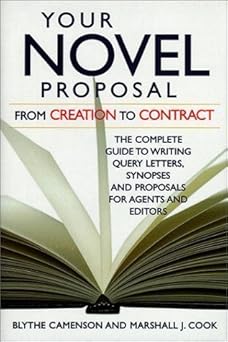
Your Novel Proposal: From Creation to Contract
By Blythe Camenson and Marshall J. Cook
1999.
Writer’s Digest Books.
Blurb Snippet: Give your novel the attention it deserves, and give yourself the best shot at getting published. Your Novel Proposal: From Creation to Contract blends visual instruction with advice from successful publishing professionals to give your work the inside advantage.
This has to be one of my older writing books—online is not yet online, but “on-line.” 😊 (Yes, there are websites listed. We’re not THAT far back into history.) This book hales from a time before e-books or self-publishing are considered respectable, viable options for indie authors. You don’t want to be selling books from the trunk of your car, do you? Of course not! Read this book. Sure, there’s a lot about formatting the printed proposal, but this book balances out the concepts they share with specific examples of what they mean. They’ve also got some very interesting cautionary tales of query etiquette, like sending whiny messages when an agent/publisher rejects a proposal.
Is this useful to a fiction writer in 2024? Know what? I actually think so. Even though it predates “on-line” submissions, I really appreciate the points about what NOT to do—especially because I could totally see myself trying to use gimmicks to get attention.
~*~

The Weekend Book Proposal: How to Write a Winning Proposal in 48 Hours and Sell Your Book
By Ryan G. Van Cleave
2014.
Writer’s Digest Books.
Blurb Snippet: Whether you are a true beginner or a seasoned writer looking to secure more book contracts, The Weekend Book Proposal shows you how to take your best ideas and create powerful proposals–quickly and professionally. No need to spend months laboring over a proposal when in just a few days you can write one that will ignite the interest of agents and editors.
Oh man, that sounds perfect, doesn’t it? Crank out a whole book proposal in just one weekend! Now granted, in Parent Time 48 Hours equals…a month or thereabouts, but still, creating a whole proposal during a school term sounded ideal to me. I bought this back before the twins were in school full-time, so I was desperate to make the most of every minute I could glean for writing. That said, Van Cleave’s book is tailored for the gig writer of nonfiction. As he puts it, “Terrific ideas presented in a professional manner are regularly rejected every day. So why spend a couple of months on a proposal when a couple of days or even a handful of hours might be enough? Why struggle for a year or two (or four) to finally land a publishing contract when you can write four, six, or eight proposals (or more) per year and have as many book contracts as you can handle?”
It’s a very, very tempting point. If a person wants to live off of writing, then one’s got to treat writing as a business with steady projects. But when it comes to original fictional storytelling, that’s pretty hard to do.
Is this useful to a fiction writer in 2024? Not really. I don’t think fiction writers should assume an agent or publisher will wait until the manuscript is done like a kid holding another kid’s spot in the lunch line. I dig the tight schedule to build the proposal itself, but a fiction writer better be ready to share more material if that proposal gets attention.
~*~

By Jody Rein and Michael Larsen
2017.
Writer’s Digest Books.
Blurb Snippet: If you want to publish a book, you must present it to agents and publishers with a knock-your-socks-off proposal. Whether you’re seeking a traditional press to publish your self-published book or trying to win over an agent for your graphic novel, memoir, or nonfiction title, you need an irresistible proposal. The better your proposal, the better the editor, publisher, and deal you will get.
Here’s the book that got me started on this whole escapade!
Every Tuesday on Instagram I share a writing book I’ve either read or scoped out. How to Write a Book Proposal is my latest from the library, and I’ve enjoyed its approach so far. It got me wondering about the other books I’ve read about proposals as well as what other books could possibly say any differently. This book, for instance, is now in the “online” realm as opposed to “on-line,” so there’s a lot more consideration for how one creates a proposal to be emailed instead of printed off and mailed. They also cover multiple genres: narrative nonfiction, cookbooks, and even graphic novels. There are samples galore, plus tips on what NOT to do so you don’t torpedo your own submission.
Is this useful to a fiction writer in 2024? Kind of. Rein and Larsen validate my earlier point about Van Cleave. Like The Weekend Book Proposal, there are a lot of helpful tips here for hooking potential agents or publishers. However, fiction writers need a completed manuscript at the ready. Granted, a SERIES proposal wouldn’t need the whole series to be written out, which Rein and Larsen cover. However, as far as a novel goes, that first installment must be available if the agent/publisher shows interest.
~*~
Do you enjoy any older books on writing? After putting this post together, I’m honestly considering this for a blog series. There is SOOOOOO much material out there, and as a number of you mentioned on my interview last week, “classic” writing books such as Stephen King’s On Writing don’t always feel like they fit one’s needs. Perhaps we can dig up some more resources next month to see what’s worth a spot on your bursting bookshelf. 🙂
Next week, I think we should see how Bash is doing. You shared such kind support for Biff in his struggle to accept change–THANK YOU! Bash has taken on a new challenge, and it’s led Bo and me down a rabbit hole we did not expect…
Read on, share on, and write on, my friends!

 Jean Lee's World
I want to read this series about older pub advice – yes! Sometimes it’s remarkable so little that had changed on the fundamentals, and other times, well, Lots of Shiny New Options On-Line 😀
LikeLiked by 1 person
Hee hee yes! I’ve actually been perusing some of my books from the 90s and requesting books that have come out in the last few years. It could make for an interesting mix of “on-line” and “What’s that newfangled world wide web-o-whatzit?” lol Thanks!
LikeLiked by 1 person
‘Sometimes I focus on character books, other times plot, other times action scenes, other times…well you get it’, there we have it, the truth. ‘Tis the way we all love writing. Nice blog, Mike
LikeLiked by 1 person
Oh yes, my friend, the paths of crafting are numerous. xxxxxxx
LikeLike
If you’re ever looking for books on plot/character development, and/or screenwriting, you might be interested in the titles I’ve listed on my Resources page if you haven’t already seen them.
LikeLiked by 1 person
Thanks for the heads up! I’ll stay on the look-out for your recommendations xxxxxxxxx
LikeLiked by 1 person
No problem.
LikeLiked by 1 person
Powerhouse collection of resources.
LikeLiked by 1 person
Thank you! xxxxxx
LikeLiked by 1 person
I can’t remember which author said this but it was something like when they were writing and needed anything for the book, it was buy a coffee and spend some time in the dusty old library. I’m hoping now with the internet, it’s so easier now. xxxxxx
LikeLiked by 1 person
Oh, I love the smell of libraries. Book scents are a favorite! xxxxx
LikeLike
Even starting to think about being an indie author again… I need to focus, focus, for me.
But you, Jean, seem to be getting there, and I’m sure you will! xxxxx
LikeLiked by 1 person
I’m trying, Chris, I’m trying! Argh it’s a lot of trying, but the act of even doing that brings me hope. I know you can do it, too! xxxxxx
LikeLiked by 1 person
[…] some resources on help with setting in nonfiction, and in mid-September I shared a post about different books focused on book proposals. You shared some lovely feedback that more posts about writing resources would be handy, so here we […]
LikeLiked by 1 person
[…] then I remembered something from the Book Proposal post I wrote a while back. Part of a strong proposal includes sharing titles that can complement […]
LikeLike