Welcome back, my fellow creatives!
In summer I shared some resources on help with setting in nonfiction, and in mid-September I shared a post about different books focused on book proposals. You shared some lovely feedback that more posts about writing resources would be handy, so here we are!
As with my September post, I’m not focusing on recently published sources; rather, I’ve got stuff from the last ten years that could potentially help you, my fellow frugal creatives, to develop a writing library that will provide useful insights now and in the decades to come.
~*~
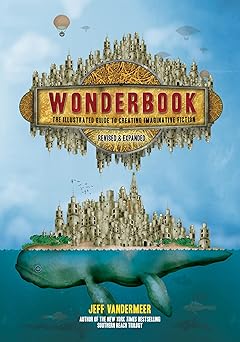
Wonderbook: The Illustrated Guide to Creating Imaginative Fiction
By Jeff Vandermeer
2013.
Writer’s Digest Books.
Blurb Snippet: From the New York Times-bestselling, Nebula Award-winning author, Wonderbook has become the definitive guide to writing science fiction and fantasy by offering an accessible, example-rich approach that emphasizes the importance of playfulness as well as pragmatism. It also embraces the visual nature of genre culture and employs bold, full-color drawings, maps, renderings, and visualizations to stimulate creative thinking.
On top of all that, it features sidebars and essays—most original to the book—from some of the biggest names working in the field today, among them George R. R. Martin, Lev Grossman, Neil Gaiman, Michael Moorcock, Charles Yu, Kim Stanley Robinson, and Karen Joy Fowler. For the fifth anniversary of the original publication, Jeff VanderMeer has added fifty more pages of diagrams, illustrations, and writing exercises, creating the ultimate volume of inspiring advice.
Firstly, I just love all the visuals in this book. The illustrations alone spark a writer’s imagination to create unique story-worlds. Several authors provide their input on different facets of storytelling. But what I love most here is the mixture of it all: the explorations of storytelling in the visuals and in Vandermeer’s voice and in the voices of the authors who contribute. Every page has something for your eyes as well as your mind to the point where reading this book is practically a multi-sensory experience.
Is this useful to a fiction writer in 2024? If you dig visual aids, you will LOVE this book. However, for those seeking a straightforward textual aid, I could see how overwhelming Vandermeer’s book could be.
~*~
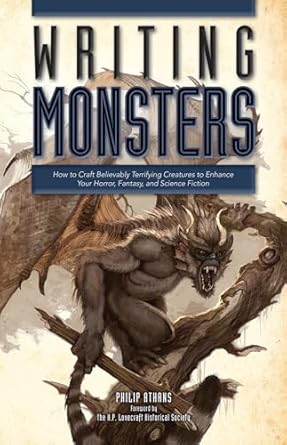
By Philip Athans
2014.
Writer’s Digest Books.
Blurb Snippet: Monsters are lurking in the woods, beneath the waves, and within our favorite books, films, and games–and there are good reasons why they appear so often. Monsters are manifestations of our fears and symbols of our society–not to mention they’re a lot of fun–but each should serve a purpose and enhance the themes and tension in your fiction.
In Writing Monsters, best-selling author Philip Athans uses classic examples from books, films, and the world around us to explore what makes monsters memorable–and terrifying. You’ll learn what monsters can (and should) represent in your story and how to create monsters from the ground up.
Yes, I know, the theme here is worldbuilding. BUT, a major part of a unique world is its creature life, and Athans’ book not only inspires potential kinds of monsters, but gets a writer thinking about the RULES of their monsters. One of my biggest pet peeves as a reader is a story changing what a person/creature can or can’t do for the sake of the plot. If the writer takes the time to establish the skills and abilities, the stakes and risks of taking a creature on become much more believable for the reader.
Is this useful to a fiction writer in 2024? Oh yes! Between the worksheets and notes on famous creatures of stories past, a writer will find a wealth of inspiration and guidance here.
~*~
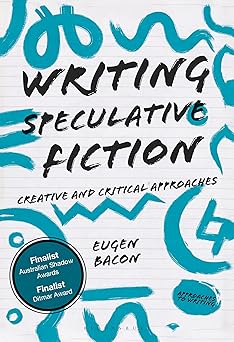
Writing Speculative Fiction: Creative and Critical Approaches
By Eugene Bacon
2019.
Macmillan International.
Blurb Snippet: In this engaging and accessible guide, Eugen Bacon explores writing speculative fiction as a creative practice, drawing from her own work, and the work of other writers and theorists, to interrogate its various subgenres. Through analysis of writers such as Stephen King, J.R.R. Tolkien and J. K. Rowling, this book scrutinizes the characteristics of speculative fiction, considers the potential of writing cross genre and covers the challenges of targeting young adults. It connects critical and cultural theories to the practice of creative writing, examining how they might apply to the process of writing speculative fiction. Both practical and critical in its evaluative gaze, it also looks at e-publishing as a promising publishing medium for speculative fiction.
While the blurb says this book is accessible, I begrudgingly disagree. This book is DENSE, my guess because it’s geared for a creative writing course. Does that make it bad per se? No, of course not. But as one who likes to skim through texts to find help with a specific thorny spot, this book doesn’t help much.
Is this useful to a fiction writer in 2024? No. It’s fine for an overview, I suppose, if you read it from start to finish, but it’s not what I consider a go-to reference.
~*~

Now Write! Science Fiction, Fantasy, and Horror
By Pam Brodowsky and Eric Neuhause
2014.
Jeremy P. Tarcher/Penguin.
Blurb Snippet: The fifth volume in the acclaimed Now Write! writing-guide series offers a full toolbox of advice and exercises for speculative fiction writers hoping to craft an engaging alternate reality, flesh out an enthralling fantasy quest, or dream up a bloodcurdling plot twist, including:
–Harlan Ellison (R), on crafting the perfect story title
–Jack Ketchum, on how economy of language helps create a truly frightening tale
–Piers Anthony, on making fantastical characters feel genuine and relatable
Among the other writers incluided are: Steven Barnes, Peter Briggs, David Brin, Sara B. Cooper, Brian James Freeman, Joe R. Lansdale, Bruce McAllister, Vonda N. McIntyre, William F. Nolan, Michael Reaves, Melissa Scott, Michael Dillon Scott, Vanessa Vaughn and others.
This collection of storytelling secrets from top genre writers—including winners of Nebula, Hugo, Edgar, and Bram Stoker awards—is essential for any writer looking to take a leap beyond the ordinary.
Now this is another book that’s geared towards a writing class, but I find this one genuinely more accessible. A dandy thing about an anthology is that if one author’s contribution does not connect with you, there are several others covering that same storytelling element, be it worldbuilding, stakes and tension, characterization, themes, etc. I also like the variety of different speakers here as opposed to presenting authors from only one sector. Every single author shares an exercise to challenge the reader, as well. Some exercises only take a few minutes, some are moreso reflection than writing, and still others take you through multiple drafts in order to study things like different sentence structures or plot changes.
Is this useful to a fiction writer in 2024? I’d say so. The variety of exercises and insights here is massive, and the book itself is very easy to jump around in depending on your writing needs.
~*~
That will do it for now, methinks! Coming up we’ll see if J.B. Fletcher can help me make some edible yams. I’ve also got to figure out what the hell to do about AI and my own feelings of seeing my story ideas applied by another writer. Another author interview is percolating, and there is bound to be a podcast at some point. 🙂
Read on, share on, and write on, my friends!
 Jean Lee's World
These are great resources for fiction writers.
LikeLiked by 1 person
Thanks! I thought so, too. 🙂
LikeLiked by 1 person
I love the graphics on the Now Write book. I am thinking about a middle school-aged book on the environment that’s peppered with drawings so great to see it’s not so far afield, Jean. Thanks for sharing.
LikeLiked by 1 person
Oh, yes yes yes! The little doodles like that keep one’s creativity going 🙂
LikeLike
Oh, excellent! Speculative fiction… my favourite genre.
(I may have mentioned this before)
LikeLiked by 1 person
Too often when reading fiction it feels like so much is invested in building a reality at the start and then it’s just forgotten about from midway on. Such a waste. The created reality adds so much to every page in a CS Lewis, Tolkien and Pratchitt novel. Xxxxxxxx
LikeLiked by 1 person
Yes, I’m with you! I’m also determined to enter Discworld and study all that beautiful worldbuilding 🙂
LikeLike