
Welcome back, my fellow creatives! I’m thrilled to continue sharing some lovely indie authors I’ve met in our community–it’s so great to connect with folks again. This month, please welcome fantasy and children’s author Nicholas C. Rossis!
Hi Jean, lovely to be here. First of all, let me say that I’ll be using em-dashes here. I know some consider them the definitive mark of AI-written copy, but I simply think of them as proper grammar. So, I hope you won’t mind them.
I don’t mind them one bit, Nicholas. I use them aaaaaaaaaaall the time–way before AI made them hip or whatever. 🙂 So, let’s begin with a wee explore of your reading life. What is your favorite childhood book?
I started reading at 2.
WHAT?! Actually, that’s a lot like my son Biff. Carry on, lol.
Yes, anyway. Take The Lord of the Rings. I read it as a teen, and Tolkien’s world-building was transformative—it showed me that fantasy could be more than escapism. It could have depth, history, and moral complexity. Plus, I was fascinated by how he created entire languages.
However, my favorite was probably Richard Bach’s Jonathan Livingston Seagull, which transformed how I saw storytelling. I first watched the movie at an open-air theater and read the book a few months later. It fascinated me right away, even if it took me a while to better understand the topics it addressed—transcendence, pushing beyond limitations, and finding meaning when the world tells you to conform.
Bach showed me that fiction could be a philosophical allegory without losing its emotional core. A short, deceptively simple book that asks profound questions about purpose and excellence. It planted seeds that grew into everything I write now, such as the idea that genre fiction can explore the biggest questions about human nature while still being, fundamentally, a story. I still return to it when I need to remember why I write.
That’s a beautiful sentiment. It’s amazing how stories guide us to experience that which is beyond our everyday experience and can teach us something deeper. Has anything else ever struck you with such a profound teaching moment?
Philip K. Dick’s work, particularly The Exegesis. It’s one of a couple of books I keep on my nightstand. Dick didn’t just write sci-fi—he explored what reality is, what consciousness means, and whether we can trust our perceptions. It taught me that fiction doesn’t need to choose between entertainment and philosophy. Genre fiction can ask the biggest questions without losing its narrative drive.
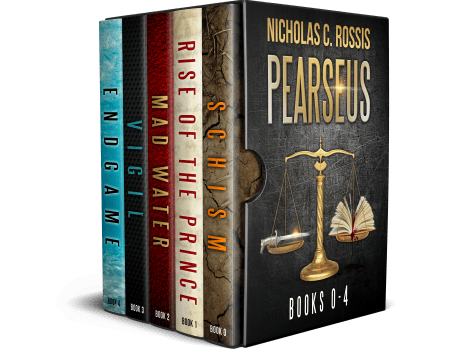
Ooooh yes, let’s dig into that a bit more! Your first series, Pearseus, is a science fantasy series that balances tough questions for readers about human nature while also engaging readers with a compelling plotline and authentic characters. That’s no small achievement in the SFF realm, where one builds up a world or even universe from scratch! How do you balance making demands on the reader with taking care of the reader?
When I gave my dad Pearseus to read, he didn’t realize I’d written it. Once he finished it (took him a few months, too), he said, “Oh, and I read that book you gave me. You know what this guy did? He took ancient Greek history and turned it into sci-fi.”
If you’re wondering what happened next, I asked, “What guy?” and he said, “I don’t know, there was no name on the manuscript.” Once I stopped laughing, I explained I’d written it and that I was glad he’d enjoyed it.
Anyway, all this to say that world-building was easy, in the sense that my dad was right: I had taken ancient Greek history and turned it into sci-fi. So, the main plotlines were already there. But a story is much more than that, as you implied. It’s about characters and their journeys. The choices they make. The questions about human nature that emerge from their struggles.
If I’m doing my job right, readers engage with moral complexity without feeling lectured. I also use familiar story structures (the hero’s journey, political intrigue) as scaffolding. When readers know where they are, they can handle conceptual challenges much more easily. And I try to make every chapter earn its place, advancing plot, character, or ideas.
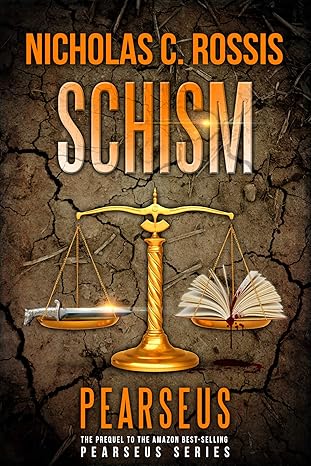
Your first book in the series, Schism, came out in 2014–over ten years ago! I’m sure you’ve seen a lot of publishing trends come and go in that time. In your eyes, what’s the most unethical practice in the publishing industry right now?
The most unethical practice? The flood of AI-generated books designed solely to exploit Kindle Unlimited’s payment system, as I describe in my post, the KENP scam. It’s not just about cluttering the marketplace. It’s fraud that steals from legitimate authors who rely on KU income. These aren’t people using AI as a tool to improve human-written work; they’re churning out garbage to game algorithms. Amazon’s been slow to address it, and it’s poisoning the well for everyone.
Uffdah, I’ll have to look into that. You’re right that it doesn’t take much to sour readers and indie writers these days. Still, you’ve kept on, and that speaks to your tenacious perseverance! 🙂 I’m sure there’s been a learning curve in there, though. How has publishing your first book changed your writing process?
It made me realize the value of proper editing. Before publication, I could endlessly tinker. After? Readers were waiting. Deadlines became real. I also learned that “finished” is better than “perfect.” My first book went through a dozen cover iterations, endless tweaks. Now I trust my instincts more and release faster.
Publishing also taught me that marketing matters as much as craft. A hard lesson for someone who just wanted to write stories!
We’re all definitely feeling that these days! What other authors are you friends with, and how do they help you become a better writer?
Rayne Hall comes to mind, as we have co-authored books on copywriting and series writing. But it’d be unfair to mention her specifically when I’ve met so many wonderful people since I started on this journey, many through RRBC and similar book clubs.
Currently, I’m part of Story Empire, a group of twelve authors who share insights on craft and publishing. Many I knew from my blog, while others are new friends.
And of course, the indie author community on my blog has been invaluable. Guest posts, interviews, blog tours—these exchanges force me to articulate what I know and expose gaps in my knowledge. Reading their books keeps me humble!
Not to mention reading the works of others exposes us to genres we may have never considered writing ourselves! I love how you don’t restrain yourself to a single genre, but go wherever your new story takes you. What inspired that shift from writing stories like Perseus and your latest book, the children’s book Everyone Hates This Restaurant?
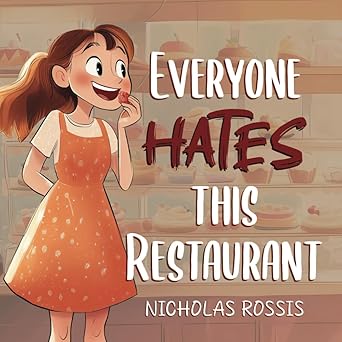
My daughter! She loves desserts so much we joke about restaurants serving only dessert. That became the seed for Everyone Hates This Restaurant. Suddenly, I was writing for her, not for my usual audience. It reminded me that stories are stories, regardless of genre. Whether I’m exploring the nature of consciousness or why nobody likes a dessert restaurant, the craft is the same: character, conflict, resolution. Genre is just the costume the story wears.
You’ve also written genre short fiction, such as the collection You’re in for a Ride. What signals do you see in a story that helps you choose whether the plot is meant for a novel or a short story?
Apparently, Abraham Lincoln was particularly lanky. He was also witty. So, when someone teasingly asked him how long a man’s legs should be, he answered, “long enough to reach the floor.” I always remember this anecdote when asked how long a manuscript should be. “Long enough to tell the story” is my go-to answer.
More practically, it depends on scope and complexity. If an idea hinges on a single moment of revelation or transformation, it’s a short story. If it requires sustained character development across multiple turning points, it’s a novel. Short stories work best with one core conflict and a tight timeframe. Novels need subplots, ensemble casts, world-building that unfolds gradually. Sometimes I start what I think is a short story and realize it’s fighting me—that’s when I know it wants to be longer.
Hmmm, that’s an interesting point about the author’s tug-of-war with a story. I’m guessing that can affect the time frame to finish a story, doesn’t it? What’s the average time frame from start to finish, you think?
It varies wildly. Short stories might take from hours to a week. A novel like Pearseus? Months of writing, then months of editing. But the real timeline starts earlier: in that dream journal on my nightstand. Ideas percolate there for months or years before I write them. So an “average” is misleading. What I can say: the writing gets faster with practice. In my day job as a copywriter, I write or edit up to 100,000 words a month. This has made me more efficient, especially when it comes to editing.
100,000 words?! Yowza, Batman! No wonder you’ve been able to strengthen your efficiency. Are there any solid writing resources that help you that you’d like to recommend to other writers?

Frankly, whatever works for them. Story Empire comes to mind, as it has industry tips from so many excellent authors who have seen it all. Also, Reedsy is a good place for marketplace connections, Writer’s Digest for craft fundamentals, and specific genre communities (like the SFWA for sci-fi writers) come to mind. For indie authors, David Gaughran’s blog and Joanna Penn’s The Creative Penn are great resources. Oh, and Quora. The historical and craft discussions there are gold for research and inspiration.
I would have never considered Quora! I’m so used to telling students that’s not academic research, but you make a great point that possibilities for further digging and inspiration could be found there. That sounds like a fine virtual adventure in the making! Real-life adventures are always nice, too, of course. What literary pilgrimages have you gone on?
I live some 20’ from the Tomb of Marathon, the place where 2,500 years ago the Athenians laid the bones of those who died defending freedom from the Persian invaders. So, living in Greece is a daily literary pilgrimage. I walk streets where ancient poets composed, visit ruins that inspired countless stories. And when I lived in Edinburgh, I explored the places that shaped authors like Robert Louis Stevenson.
But the most meaningful pilgrimage is internal: praying, meditating, diving into my dream journal every morning. That’s where I excavate the strange, subconscious narratives that feed my fiction.
Thanks again for taking time to chat with me! Let’s end with a bit of motivation. If you could tell your younger writing self anything, what would it be?
A couple of things. First, don’t wait for permission. Younger me agonized over whether my work was “good enough” to share. I rewrote endlessly, seeking some external validation that never came. Here’s the truth: you get better by finishing and sharing, not by polishing in isolation. Your first book won’t be your best. That’s okay. Each book is practice for the next. Write badly, publish anyway, learn publicly. Your readers will forgive rough edges if you give them an authentic story.
Second, don’t fret about making a living out of fiction writing. Realistically speaking, success in our world is measured in handfuls of sales each month, not earning five figures. So don’t stress about the outcome, or it will steal away the joy of writing. Focus instead on the journey and enjoy every moment of it.
And for God’s sake, start that blog earlier! The connections you’ll make are worth more than perfect prose.
Yes! I started my blog years before publishing, too, and it made such a difference to have an author community to share it with. I wouldn’t be here if it weren’t for my amazing fellow creatives!
Folks, you can check out Nicholas C. Rossis’ insights and books on his site. I hope you stop by and say hello!
Coming up, I want to talk about ignoring a major storytelling trend, some more inspiring music, and of course, another podcast episode is on its way. Stay tuned!
Read on, share on, and write on, my friends!


⭐️⭐️⭐️⭐️⭐️
LikeLiked by 1 person
Thank you!
LikeLiked by 1 person
Hi Jean and you’re welcome! Wishing you a happy weekend…😊⭐️🎶⭐️😊
LikeLike
Another fine blog, this time outstanding with Nicholas. All I can say is ‘outstanding’. Regards, Mike
LikeLiked by 1 person
Ah, always good to have you here, my friend! xxxxx
LikeLike
What an insightful interview with Nicholas. I thoroughly enjoyed all of this. Such great information, tips and thoughts. I, too, love Jonathan Livingston Seagull and it still sits on my bookshelf even after 40 years. Thank you for diving deep into the mind of Nicholas Rossis, Jean!
LikeLiked by 1 person
And I thank you for stopping by, Jan! I do so love sharing my fellow authors here. xxxxx
LikeLiked by 1 person
You certainly manage to introduce us to the most interesting people.
LikeLiked by 1 person
It’s been a blessing, Peggy, to meet lovely souls like you! xxxxx
LikeLiked by 1 person
Thanks for another great interview. I particularly liked one piece of advice given about stressing less and enjoying the journey more.
LikeLiked by 1 person
Thanks, Diana! I agree. I try to remember this so I don’t bang my head on the keyboard. xxxxxx
LikeLiked by 1 person
Thanks for sharing your stories, lessons, and encouragement, Jean and Nicholas!
LikeLiked by 1 person
ANNE! Always happy to see you here, my friend! xxxxxxxxx
LikeLiked by 1 person
Gosh that was really interesting! Well done, Jean and Nicholas.
LikeLiked by 1 person
So glad you’re here, my friend! xxxx
LikeLiked by 1 person
Thank you so much for the great questions, Jean! It’s been such a pleasure being here 🙂
LikeLiked by 1 person
I’m so thankful you were able to chat with me! xxxxx
LikeLiked by 1 person
Terrific interview.
I hadn’t thought about Jonathan Livingston Seagull in eons. It was a huge bestseller circa 1970. I haven’t read it. But maybe it’s time for me to do so!
LikeLiked by 1 person
It’s never too late to pick up a new book, my friend! xxxxx
LikeLiked by 1 person
another wonderful interview my friend xxxxxxx
LikeLiked by 1 person
Always glad to have you here, my friend! xxxxx
LikeLike
Another fantastic interview, Jean! Nicholas is a favorite!
LikeLiked by 1 person
Thank you so much for reading, Beem! xxxx
LikeLiked by 1 person
Also a fan of the em-dash!
I do like to insert spaces before and after them though – I’m a rebel!
(Didn’t know they had become an AI thing )
)
LikeLiked by 1 person
I’m a fan of the dashes, too–I just never bother putting spaces around them, lol. Thanks for reading!
LikeLiked by 1 person
I think your way is correct actually!
Just checked and both are ok, according to MW. No spacing is common in books while spacing is usually used in newspapers.
J
LikeLike
[…] why I’m happy to share fellow Story Empire resident Nicholas Rossis‘ latest post on the state of publishing. He highlights some genuinely good uses of AI for […]
LikeLike