Welcome back, my fellow creatives! I’m thrilled to continue sharing some lovely indie authors I’ve met in our community–it’s so great to connect with folks again. This month, please welcome historical and romance author Jan Sikes!
Let’s start with your reading life. What’s your favorite under-appreciated novel?
That’s a hard one to answer because I’m not sure what under-appreciated means. So, I’ll just go from my own perspective. Just last year, I read a novel by an Indie Author, Shanna Hatfield. The Bridge was such a complex interwoven story. It hooked me from the first page and didn’t let go. I was in awe of how the author wove all these different characters together into a complex story based on one man’s action on a bridge on Christmas Eve. Talk about a ripple effect! I highly recommend it.
That sounds wonderful! There’s something special about having this kind of secret, that book you’re always eager to share. But not every book is going to hit us the same way. On my podcast, I like doing first chapter book reviews because there are times a first chapter just does not catch my interest. Have you ever gotten reader’s block?
Oh, definitely. But if I can’t get invested by the second or third chapter of the book, I put it down. At 74 years of age, I don’t have time left in my life to force myself to read something I don’t enjoy, or get lost in.
I don’t think any of us have time to books we don’t connect with, that’s for sure. We want the books that grip our hearts and souls. How about the first book that made you cry?
To the best of my memory, the first book that made me cry was Old Yeller. I loved that story so much, but it was so sad because the dog, Old Yeller, died. The most recent book I read that made me not only cry but sob, was The Last Letter by Rebecca Yarros. That book literally ripped my heart out of my chest, threw it on the ground and stomped on it.
Your Bargainer series also strikes folks on a deep, emotional level.
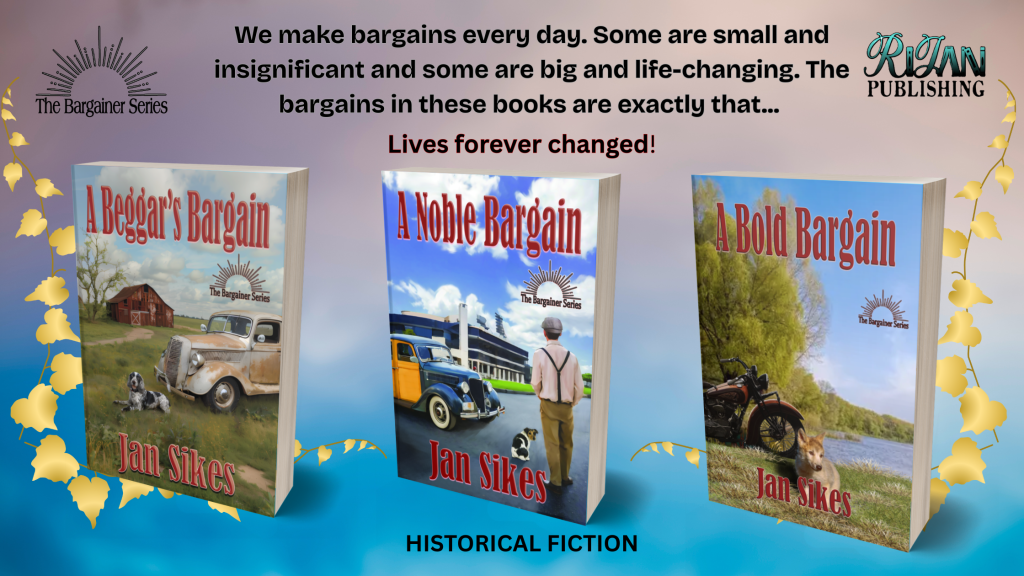
They tell stories of resilience and hope set in the middle of the 20th century. What kind of research do you do, and how long do you spend researching before beginning a book?
Thank you for mentioning The Bargainer Series! The research I had to do for that series was the most fun ever! The stories are set in Missouri and Arkansas and I traveled to the areas to explore, talk to the people and see the lay of the land. I spent a lot of time in the Dade County, Missouri Library as well as the Crossett Arkansas Public Library. I had already started writing the first book in the series before I went to Missouri and I had to come home and change some scenes. It’s important to me to stay true to the time period and setting. I looked at hundreds of online newspapers from the 1940s and learned a lot about the goings on locally and in the nation. I included some of those historic facts in the stories. I love hands-on research!
Oh man, I get lost in research so easily, especially when it’s a period I don’t know very well. Do any of your historical stories utilize historical figures or events? If so, how do you handle these factual pieces of history in an ethical way?
As I said above, the newspapers I perused gave me some fun historical facts to use. For example, I found one newspaper article in 1947 where President Truman issued a plea to the American people to set aside one day per week not to eat meat as there was still a shortage from World War II. Even though the war had ended in 1945, America had not yet fully recovered. It was easy to weave that little tidbit into the story.
You’ve been publishing for over ten years, gathering oodles of book reviews along the way. After reading the Story Empire blog series about writers and book reviews, I can’t help but ask if you read your own book reviews. How do you deal with bad or good ones?
I always read my reviews. I can learn and grow from them. The good ones make me glow and the bad ones make me take a closer look at the work to see if I can make it better. The worst review I ever got was live on a zoom podcast, where a reader ripped me and my story apart. It was so hard to sit there with a smile on my face and take it. The minute I was off camera, I burst into tears. Needless to say, I immediately separated myself from that organization and moved along. There are bad reviews and then there are mean reviews. I don’t do mean.

Oh my HEAVENS, I don’t think I could have remained as professional as you did. Your experience reminds me of my first graduate writing workshop, where my rough draft got shredded by nearly the entire class, teacher included. I had a good, long bawl after that. But by the end of three years, I felt like I could dare peers to throw their worst at me, because I had already lived the worst. I’m glad you rose above the occasion and proved yourself the kinder soul! Writing itself is already tough. Looking back across your publishing history, what would you say was your hardest scene to write, and how did you work through that struggle?
That’s a tough question. I can think of several scenes that were hard to write, but especially when I was writing the true story series. Knowing where to draw the line with how much to share was the biggest lesson with that one. Besides that, violent scenes are difficult for me to write, because I am not a violent person and have never really been exposed to violence. So, I can struggle a little with those.
Is there a stage in your artistic process that’s always more challenging than the rest of it? Knowing when to stop the research process is one of mine!
Honestly, I can’t say there is any difficult part to the artistic process. I absolutely love getting new story inspirations. It’s exhilarating. The difficult part of this business is not in the creation of the stories, but the marketing. That’s where it gets difficult.
Gah, that marketing! You’re right–things get very tricky there. But I would have wondered if writing from the male perspective would be a challenge for you; I’m working with male POVs in my WIP, and it’s tough! You utilize the male perspective in a number of your stories, such as Saddled Hearts. What’s the most difficult thing about writing characters from the opposite sex?
For me the most difficult part of writing the opposite sex is in the dialogue. Men use way fewer words than women and I tend to be wordy. So, learning to cut it down and keep it lean is a challenge. Men also don’t normally express their feelings the way women do, so again, keeping it lean helps in keeping it real.

We’re all in different stages of life, so our writing routines are going to differ A LOT. How would you describe your daily (or weekly!) writing routine?
When I am working on something new, I prefer morning time. However, because I’m so anal about it, I have to get emails out of the way before I can settle in to write. Then, I disconnect from the internet and focus on my story. It has to be quiet when I work. I’m not the kind of person who can write in a noisy place or listening to music. I get too distracted and my mind wanders.
I know what you mean! I really like writing in the morning, but when there’s a pile of school work sitting in front of me, it’s hard to ignore those essays and focus on creativity. That, and my ears are always anxious about the phone ringing and it’s the school principal. There goes the creativity. 😦 What is your writing Kryptonite?
I’d have to say it’s time. There is never enough time in a day, especially since I work two jobs. So, carving out the time I need is hard. For example, when the words are flowing, the ideas are there and the story is unfolding, I hate having to stop and move on to one of the jobs. Still, if I can stay focused and disciplined, I can get a lot accomplished in a short time.
And that is what I need to remember, too: we must make every minute count! Thank YOU for sharing your time with us and chatting about your reading and writing life. Let’s close out with some recommendations. What are your favorite literary journals/websites you’d like to recommend to us today?
I’ve been a member of The Story Empire group for several years, and I have learned so much from the different authors who have contributed content to the blog, so that’s at the top of my list. I also subscribe to and enjoy Writer’s Helping Writers and Writers in the Storm. My favorite literary journal is the Texas Lone Star Literary Magazine. I used to do book reviews for them and still enjoy the publication.
Thanks much, Jan, we’ll have to check them out! Folks, you can see Jan’s kickin’ work on her website as well as on The Story Empire.
Coming up, I’ve got my own monthly travels into The Empire as well as a podcast and some thoughts about bucking trends…and maybe a silly interlude, if academic life steamrolls over my time, lol.
Read on, share on, and write on, my friends!


Another outstanding blog my friends. All the best, Mike
LikeLiked by 3 people
Thank you, Mike! I appreciate you taking the time to read this post.
LikeLiked by 2 people
Thank you kindly, my friend! I hope you had a good Easter. x
LikeLike
This was so much fun, Jean. I loved answering the questions. I deeply appreciate the opportunity to show up here on your blog!
LikeLiked by 3 people
Thanks so much for taking time to chat, Jan! I’m honored to share this sphere with you. x
LikeLike
What a fascinating interview. It would be wonderful to have Jan as a guest at dinner.
LikeLiked by 2 people
I would love to have dinner with you, Peggy!!
LikeLiked by 2 people
Kangaroo stew for dinner tonight.
LikeLiked by 2 people
I agree, Peggy! I hope the kangaroo stew was tasty. xxxxx
LikeLiked by 1 person
A great interview. Thanks for sharing. I had honestly never heard of Jan Sikes, but your post made me want to click on her site!
LikeLiked by 3 people
Yay! That is music to my ears, Diana! Thank you for taking the time to read the interview!
LikeLiked by 2 people
I’m so glad, Diana. I’m sure you’ll dig her!
LikeLiked by 1 person
Such a good interview – well done both of you, Jean & Jan!
LikeLiked by 3 people
Thank you, Chris. So glad you enjoyed it!
LikeLiked by 2 people
Thank you, my friend! I hope you had a lovely Easter xxxxx
LikeLiked by 1 person
A wonderfully entertaining interview!
LikeLiked by 1 person
So glad you dug it! xxxx
LikeLiked by 1 person
So much to unpack here. I’ll just say that I love hearing the stories about creation.Actually going to the site and visiting the libraries sounds wonderful. I also struggle with time and it seems there is never enough.
LikeLiked by 1 person
No matter what we do, my friend, that clock never seems to grow our hours. Thanks for reading!
LikeLiked by 1 person
Loved this! As Craig said, so much to unpack, from staying cool under pressure to the fun of research and the challenges of carving out time to write. If interviews were meals, this’d be a 3-course one!
LikeLiked by 1 person
I love that analogy! Thanks so much for reading xxxx
LikeLiked by 1 person