Lessons Learned from Philip Reeve: Balance Familiarity and Innovation in Fantasy Worlds
Welcome back, my fellow creatives!
When it comes to science fiction or fantasy, a writer must have solid world-building from the get-go. You know this, I know this. We’ve got it. End of post!
Okay, so why am I hear? Because one of the big challenges for writers in these genres is pacing that worldbuilding work. Readers don’t want to feel dumped on with information, nor do they want to be overwhelmed by the unfamiliar. This will only result in frustrated readers who won’t want to continue past the first chapter.
That’s why I wanted to study Philip Reeve’s Railhead with you. Yes, part of this is because I want to write my own “trains in space” kind of story, but I think we can all benefit from seeing how Reeve uses what is familiar to build what is unfamiliar to his audience. And with all this, he paces that galactic development so readers never feel overwhelmed. That’s a major feat, and worth a study.
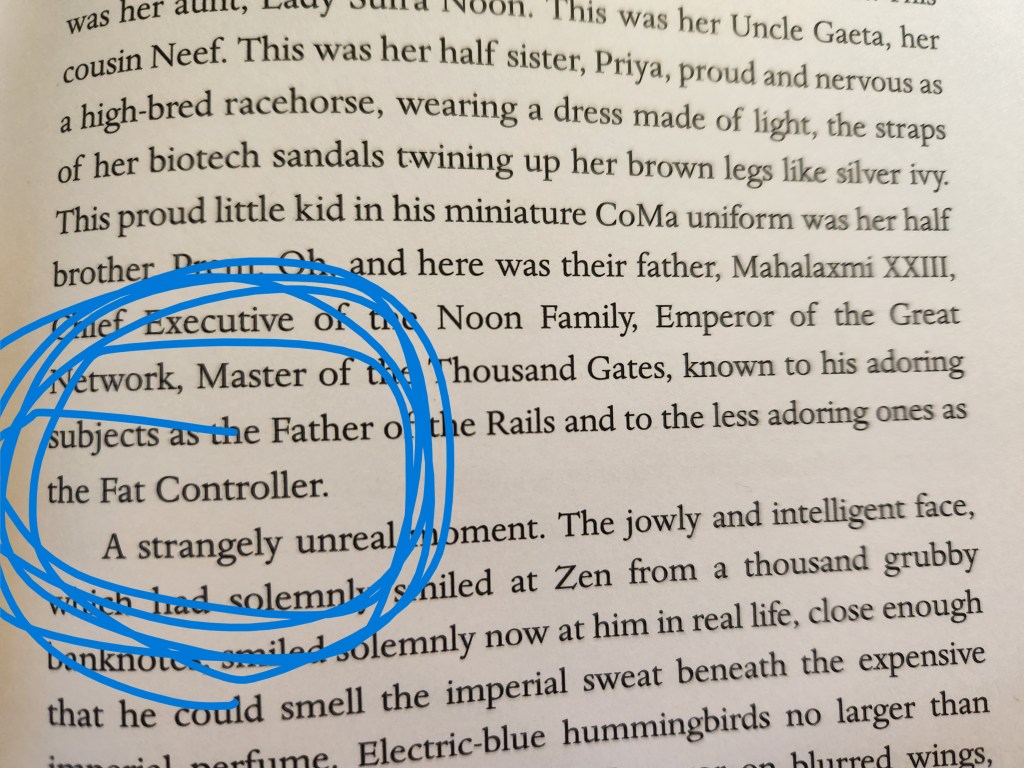
Let’s take a look at the first page here.
Listen…
He was running down harmony when he heard it. Faint at first, but growing clearer, rising above the noises of the streets. Out in the dark, beyond the city, a siren voice was calling, lonely as the Song of whales. It was the sound he had been waiting for. The Interstellar Express was thundering down the line from Golden Junction and singing as it came.
He had an excuse to hurry now. He was not running away from a crime anymore, just running to catch a train. Just Zen Starling, a thin brown kid racing down Harmony Street with trouble in his eyes and stolen jewelry in the pocket of his coat, dancing his way through the random gaps that open and closed in the crowds. The lines of lanterns strung between the old glass buildings lit his face as he looked back, looked back, checking for the drone that was hunting him.
We’ve already got a fair amount of worldbuilding in these two paragraphs. The Interstellar Express cues us in to the concept of cosmic travel. The phrase “thundering down the line”, now–that’s a very common description associated with trains. Even if folks haven’t ridden a train–let alone a train in space–the concept of a train coming down the track is an accessible one for a huge variety of readers. We also get a quick sense of our protagonist, the “thin brown kid” who’s stolen something and is now running away with it. Reeve cannot dwell on any detail for long, as it wouldn’t make sense for the character, and all momentum would grind to a halt.
Who’d have thought that the goldsmith would send a drone after him? Zen had come to believe that the merchants of the Ambersai Bazar didn’t much mind being robbed, as long as you didn’t steal too often from the same shop. Like maybe they felt a bit of pilfering was a price worth paying for a pitch in the biggest market on the eastern branch lines. For as long as anyone could remember, the Bazar had been a happy hunting ground for people like Zen who were young and daring in dishonest, the low heroes of this infinite city.
AmberSai was a big moon. The dirty yellow disc of its mother-world gazed down upon the busy streets like a watchful eye, but it never seemed to notice Zen when he filched food or bangles from the open-fronted shops. Sometimes the shopkeepers noticed, and chased him, bellowing threats and waving lathi sticks, but they mostly gave up after a street or two, and there were always crowds to hide in. The Bazar was busy day and night. Not just cafes, bars, and pleasure shops, but the stalls of the craftsman and metal dealers too. There was a whole district of them, selling stuff that the deep-space mining outfits brought in. Ambersai’s local asteroid belt was as full of precious metals as an expensive necklace.
By coincidence, an expensive necklace was just what Zen had lifted that night, He could feel it in his pocket, swinging against his hip as he went down the greasy stairs toward the station and the approaching train.
Okay. Again, we have some familiar concepts here: a market with shops that don’t like thieves. Thieves typically have to run or be prosecuted. Got it. But we’re also on a different planet. Reeve doesn’t dwell on what makes it different–only that it has a “dirty yellow disc of its mother-world” in the sky. That’s it. And this, I think, is a strong strategy of Reeve’s through Railhead. Dozens of worlds are mentioned, ridden by, or visited only briefly. One can’t provide in-depth descriptions of all of these places. So Reeve keeps descriptions limited to a few sentences at most. More often than not, Reeve uses a strong, single phrase as a loco passes through one planetary gate after another.
Un-bang. Tarakat: chimneys belching vapor and some big moons hanging. Un-bang. Summer’s Lease: white streets above a bay; the kind of place people like Zen could only dream of living. Un-bang. Tusk: ain’t gas planets tilting their rings like the brims of summer hats across a turquoise sky. …
At the heart of the Great Network lay Grand Central. All the main lines of the galaxy met there, which meant that whichever corporate family controlled Grand Central controlled the whole Network…Portraits of the Noon Emperors and Empresses beamed down from holoscreens, and the smiling golden sun of Noon flapped on bright banners above a garden city, which covered half the planet, the buildings spread wide apart, diamondglass towers and golden station canopies rising from a sea of trees.
See how quick those come and go? We Earthlings can picture chimneys. We can picture white streets. We can picture hats. We can picture a lot just with the phrase “garden city.” Protagonist Zen lives on a hollowed-out mining planet named Cleave, and that, too, is something we readers can understand: industries come, they take, and they go. We see it on Earth, and Reeve amplifies that to a planetary level for his series. Train stations and locos, too, are framed with things we understand before described with the strange and new.
Locos can talk, love, and gleefully destroy? All of this happens in Railhead.
Ambersai Station: grand and high-fronted like a great theater, with the K-bahn logo hanging over its entrance and letters of blue fire. Booming loudspeaker voices reciting litanies of stations. Moths and Monk bugs Monk bugs swarming under the lamps outside; beggars and street kids too, and buskers, and vendors selling fruit and chai and noodles, and rickshaw captains squabbling as they touted for fairs. Through the den and chatter came the sound of the train.
Zen went through the entrance barriers and ran out onto the platform. The Express was just pulling in. First the huge loco, a Helden Hammerhead, its long haul sheathed in shining red-gold scales. Then a line of lit windows and a pair of Station Angels flickering along the carriage sides like stray rainbows. Some tourists standing next to Zen pointed at them and snapped pictures that wouldn’t come out. Zen kept his place in the scrum of other K-bahn travelers, itching to look behind him, but knowing that he mustn’t because, if the drone was there, it would be watching for just that: a face turned back, a look of guilt.
What on earth are Station Angels? That’s a mystery we won’t understand for a while yet, but it’s a great Unfamiliar Thing to mix up the Familiar Things we see in a station. “Old Earth” is mentioned more than once, including animals that were recreated genetically and adapted for different planets: triceratops are like dogs now, and manta rays fly through the sky. These ties back to Old Earth happen with language, too, thanks to the Guardians and the Datasea, where even the emails of Old Earth are stored.
Human beings had always dreamed up gods to guide and guard them, and the Guardians were the last, best gods they had ever invented. Artificial intelligences, created on Old Earth, as immortal and all-knowing as the gods in old stories. It was the Guardians who had opened the K-gates, and helped the corporate families lay ou the rails and stations of the Great Network.
Once again, a few passing thoughts from our protagonist early in the story provide enough worldbuilding for readers to see more structure to the world without understanding what precisely the Guardians are or how exactly those K-gates work to transport locos between planets. Readers don’t need that right away–only the promise that more clarity will come as the story progresses.
This balance between Familiar and Unfamiliar is one of the biggest challenges for genre writers–at least, I feel this as I develop Line the Stars. Because I’m working with the world of trains, my worldbuilding utilizes locomotive history–the evolution of the engines, how lines work, the language of rail workers. This research also took me down a fascinating path studying the advent of flight vs. rails. Perhaps my Empire, as it found wings, left those rails to the vagabonds and ne’er-do-wells. Left to rot.
But that which is Forgotten is not always Lost.
As I write, I’m eager to find out just what the Empire has forgotten, and what some Earthlings like you and me are going to do about it. And so long as I provide some Familiar Footing for you, my friends, you’ll uncover the Unfamiliar and find out, too.
~*~
I hope you’re ready for some interviews and podcasts in the weeks ahead! Music also awaits us alongside the coming-of-age struggle, Autism Edition.
I know! I’m guessing this is why shows like Star Wars or Star Trek rarely visited more than one spot on a planet. How could one possibly create sooooooooooooooooooo many kinds of places? My brain melts at the thought, lol x
Nice! This is actually a very timely post for me as I dust off a world I started crafting about 25 years ago 😮 I appreciate the reminder to ease readers in, no one wants to feel like they need to bring an imaginary encyclopedia along for the ride. I know when I’m in the role of reader, I don’t want too much floofy detail hurled at me right out of the gate. Let me get my bearings and a vague sense of what’s going on before you tell me there’s an octo-potamus floating behind me.
Yes, exactly! I’ve read books, mysteries and fantasies alike, where that first chapter is just a DUMP of information. I don’t mind one water balloon hurled at me, but please turn off the firehose, lol. Thanks for reading!
That’s a problem I sometimes have with sci fi novels, they go too far. So far that I can’t picture that world in my mind. The best books paint the best most vivid pictures in my head xxxxxx
Ooh, this is very much in my wheel-house – everything seems perfect for something I would read. Sci-fi and magic trains… fab as it starts. So, yes please! Good one, Jean xxxxx
[…] to see what Author So-and-So did, what makes Such-and-Such Trope so trendy, how that tidbit about trains could work in outer space (just me?). Plus there are the pressures to read what those big-time publishers and reviewers say […]





 Jean Lee's World
Mr Philip Reeve certainly knows what he is up to. A superb mind he has. I fine blog as ever Ms. Jean Lee. Regards, Mike
LikeLiked by 1 person
He really does! Many thanks, my friend xxxxx
LikeLiked by 1 person
This is a useful study. Thanks for sharingSteffSent from my iPhone
LikeLiked by 1 person
Many thanks!
LikeLike
Wow, what talent. I can barely imagine all our planet has, let alone conjure up another.
LikeLiked by 1 person
I know! I’m guessing this is why shows like Star Wars or Star Trek rarely visited more than one spot on a planet. How could one possibly create sooooooooooooooooooo many kinds of places? My brain melts at the thought, lol x
LikeLiked by 1 person
Nice! This is actually a very timely post for me as I dust off a world I started crafting about 25 years ago 😮
I appreciate the reminder to ease readers in, no one wants to feel like they need to bring an imaginary encyclopedia along for the ride.
I know when I’m in the role of reader, I don’t want too much floofy detail hurled at me right out of the gate. Let me get my bearings and a vague sense of what’s going on before you tell me there’s an octo-potamus floating behind me.
LikeLiked by 1 person
Yes, exactly! I’ve read books, mysteries and fantasies alike, where that first chapter is just a DUMP of information. I don’t mind one water balloon hurled at me, but please turn off the firehose, lol. Thanks for reading!
LikeLiked by 1 person
That’s a problem I sometimes have with sci fi novels, they go too far. So far that I can’t picture that world in my mind. The best books paint the best most vivid pictures in my head xxxxxx
LikeLiked by 1 person
Yes, my friend, exactly! We’ve got to find that balance or we leave readers behind.
LikeLike
Ooh, this is very much in my wheel-house – everything seems perfect for something I would read. Sci-fi and magic trains… fab as it starts. So, yes please! Good one, Jean xxxxx
LikeLiked by 1 person
I hope you get a chance to read it! I’m in line to read the second book 🙂
LikeLiked by 1 person
Such sharp and compelling narrative. Kudos to Mr. Reeve and thanks for sharing, Jean.
LikeLiked by 1 person
And thanks for swinging by, Pam! xxxxx
LikeLiked by 1 person
I always learn something here, Jean. xo
LikeLike
[…] to see what Author So-and-So did, what makes Such-and-Such Trope so trendy, how that tidbit about trains could work in outer space (just me?). Plus there are the pressures to read what those big-time publishers and reviewers say […]
LikeLike